Thirteen Federal Judges President Trump May Elevate to the Court of Appeals in His Second Term

Last week, we looked at thirteen district court judges who would be strongly considered for elevation to the Court of Appeals under a prospective President Biden.  This week, we’ll look at thirteen district court judges who would be considered for elevation by President Trump if he is re-elected to a second term.  As we did last week, we’ll limit our pick to thirteen judges, one for each Court of Appeal.

Judge Trevor McFadden (D.D.C.)

Judge Trevor McFadden is not only the youngest member of the U.S. District Court for the District of Columbia (McFadden is only 42), but he is also the most conservative.  In his three years on the bench, McFadden has racked up a number of rulings in favor of the Trump Administration, including ruling that the House of Representatives lacks standing to enforce its appropriations in court and in delaying the House suit seeking the President’s tax returns.  McFadden’s bid for the D.C. Circuit would be hampered by the hundreds of qualified D.C. conservatives who’d want such a post, but if the Administration wants a district court judge, McFadden would be their expected pick.

Judge Lance Walker (D. Me.)

Maine Judge Lance Walker may seem like an idiosyncratic choice for the Trump Administration to elevate, given his past decisions against anti-abortion groups and his ruling that essentially singlehandedly ensured the ranked-choice election of Democrat Jared Golden.  However, Walker, who would be only 51 when Judge William Kayatta would become eligible for senior status in 2023, is also a longtime member of the National Rifle Association and the Federalist Society.  Given this and his bipartisan confirmation to the district court, Walker may well be an ideal choice for Trump for this left-leaning circuit.

Judge Rachel Kovner (E.D.N.Y.)

Judge Rachel Kovner certainly has the pedigree to sit on the Second Circuit, having clerked for Judge J. Harvie Wilkinson and for Justice Antonin Scalia.  Also considering that Kovner has argued 11 cases before the U.S. Supreme Court and was confirmed with an overwhelming 88-3 margin, it seems more a matter of when, rather than if, Judge Kovner will be elevated.  While the forty year old judge has time on her side, she is likely to be closely scrutinized in a second Trump Administration.

Judge William Stickman (W.D. Pa.)

There is a good chance that Chief Judge Brooks Smith on the Third Circuit will move to senior status upon the conclusion of his term as Chief Judge in 2021, and Judge Stickman, who would only be 42 then, will likely be one of the leading contenders to replace him.  Despite a conservative record, Stickman had the support of Democratic Sen. Bob Casey in his district court confirmation, although, as Judge Peter Phipps experienced, support on the district court level is not a guarantee of support for an appellate seat.

Judge Thomas Kleeh (S.D.W.V.)

The 46 year old Kleeh has largely avoided making waves in his two years on the federal bench.  Nonetheless, Kleeh, who has strong connections with the West Virginia legal community, would likely be first on the list if Judge Robert King moved to senior status in a second Trump term.

Judge Brantley Starr (N.D. Tex.)

Judge Brantley Starr, who was confirmed to the Northern District of Texas last year has already made a name for himself on controversial cases, ruling that the federal government couldn’t ban bump stocks without compensating individuals under the Takings Clause, and his background prompting a transgender plaintiff to ask the judge to recuse himself from her case.  The 41 year old Starr is primed for a Fifth Circuit appointment, potentially if the equally conservative and inflammatory Judge Edith Jones moves to senior status in a second Trump term.

Judge Hala Jarbou (W.D. Mich.)

We’re cheating slightly with this one as Judge Jarbou has not yet been confirmed to the federal bench, but a vote on her nomination has been teed up for September, and she will likely sail to confirmation.  With two Michigan judges on the Sixth Circuit eligible for senior status and a third set to become eligible next year, the 49-year-old Jarbou would make a readily confirmable nominee, even if the Administration faces a Democratic Senate.

Judge Martha Pacold (N.D. Ill.)

The 41 year old Judge Pacold, despite having clerked for Justice Clarence Thomas and having a conservative’s dream resume, was nearly unanimously confirmed by the U.S. Senate to the trial court.  While it is unclear if she would attract that level of support if elevated to the Seventh Circuit, she is likely to be considered the leading candidate to replace Judge Ilana Rovner if she retires in a second Trump term.

Judge Sarah Pitlyk (E.D. Mo.)

If Judge William Duane Benton moves to senior status in a second Trump term, expect the shortlist for his seat to essentially consist of one candidate: Pitlyk.  The 43 year old Pitlyk, who squeaked to confirmation over bipartisan opposition, would be a dream candidate for conservatives, given her vocal support for Justice Brett Kavanaugh’s nomination and her strong anti-abortion record.

Judge Dominic Lanza (D. Ariz.)

It’s interesting that Lanza is a strong contender for the Ninth Circuit in a second Trump term given the fact that he was already rejected for a Ninth Circuit seat once by Trump.  The 44 year old jurist was originally recommended to be appointed to the Ninth Circuit by Sens. John McCain and Jeff Flake, only to be rejected by the Trump Administration, who were pushing Administration attorney James Burnham.  Ultimately, the Administration went with the Senators’ second choice, Judge Bridget Bade, and Lanza got a consolation appointment to the district court.  Now, Lanza, who was recently in the news for rejecting challenges to Arizona’s mail-in-ballot deadlines, will be closely watched for the Ninth Circuit if Judge Andrew Hurwitz moves to senior status in 2022.

Judge Patrick Wyrick (W.D. Okla.)

The 39-year-old Judge, who previously served on the Oklahoma Supreme Court, was previously the youngest nominee on President Trump’s Supreme Court shortlist.  Few believe that Wyrick will be tapped for the highest court without building a record on the Court of Appeals, and if an Oklahoma vacancy opens (neither of the 10th Circuit’s Oklahoma judges will be eligible to retire in the next four years), Wyrick’s name will be at the top of the list.

Judge Roy Altman (S.D. Fl.)

The 38 year old Altman was the youngest district court judge in the country when he was appointed in 2019, and, despite that youth, he sailed to confirmation by a 2-1 margin, a landslide among recent confirmation votes.  Altman will likely be strongly considered for a seat on the Eleventh Circuit if Judge Charles Wilson moves to senior status in a second Trump term, or if Judges Lagoa or Luck are elevated to the U.S. Supreme Court.

Judge Amos Mazzant (E.D. Tex.)

The Federal Circuit generally attracts less controversy than the other courts of appeals, which may be a reason for the Trump Administration to tap one of many young lawyers it has named to the Court of Federal Claims.  However, if it chooses an Article III appointee, Judge Amos Mazzant, who currently serves on the Eastern District of Texas, is a possible choice.  Judge Mazzant may have been named to the bench by President Obama, but he’s a strong conservative who was recommended by Sen. Ted Cruz.  Additionally, the 55-year-old Judge Mazzant has over a decade of experience on the patent heavy docket of the Eastern District of Texas, which would prepare him well for the Federal Circuit.
Thirteen Federal Judges the Next Democratic President May Elevate to the Court of Appeals

With the COVID-19 pandemic on everyone’s minds, judicial nominations have largely been on the backburner for the last few months.  While a few more district nominees will likely be processed in the next few months, it’s safe to say that the victor of the 2020 election will nonetheless have many judicial vacancies to fill in the next four years.

Since speculation is what this blog enjoys most, let’s think about potential candidates for the federal appellate bench under a Democratic President.  We’ll start by looking at federal district court judges who are poised for elevation to the appellate bench, and, for the sake of geographic diversity, we’ll limit our pick to thirteen judges, one for each Court of Appeal.  As such, here are 13 district judges who would be strongly considered for elevation if a Democrat was elected in 2021.

Judge Ketanji Jackson (D.D.C.)

Here’s my first prediction: Jackson will be the first Democratic nominee to the D.C. Circuit in 2021, potentially replacing Judge Judith Ann Wilson Rogers, another black woman.  Jackson, a clerk of Justice Breyer, has impressed enough to seriously be considered for a Supreme Court appointment in 2016.  At 49, Jackson has another 10 years or so of viability for a Supreme Court appointment, and it would not be surprising to have her be the first black woman on the court.

Judge Mary McElroy (D.R.I)

Judge Ojetta Rogeriee Thompson is eligible for senior status in 2021, and Judge McElroy would be the frontrunner to replace her.  This is particularly unusual given that McElroy is a Trump appointee.  However, McElroy’s Trump appointment is an anomaly.  She is a Democrat and her nomination was championed by Democratic Senator Sheldon Whitehouse.  Furthermore, McElroy’s long career as a public defender would bring a fresh perspective to the First Circuit, which is dominated by former prosecutors.

Judge Jesse Furman (S.D.N.Y.)

I feel fairly safe in saying that Furman will be at the top of Democratic lists for elevation to the Second Circuit given his role in the suit over the Census Citizenship question.  Throughout the complicated nature of the litigation, Furman maintained firm control of the proceedings, and his judgment was largely upheld by the Supreme Court.  Interestingly, Furman was the target of an oblique critique from Justice Thomas who suggested he was “predisposed to distrust” Trump.  Despite Justice Thomas’ broadside, a majority of the Supreme Court sided with Furman’s position on the Census Question.  At 47 years old, Furman is perfectly placed for elevation in 2021 or even in 2025, when he would only be 52 years old.

Judge Cathy Bissoon (W.D. Pa.)

When she was appointed in 2011, Judge Cathy Bissoon was both the first Hispanic and the first Indian American judge on the Western District of Pennsylvania.  Today, the 51-year-old judge is poised for elevation to the Third Circuit, which desperately needs more female judges, down to just two out of fourteen.

Judge George Hazel (D. Md.)

At 45 years old, Hazel is the youngest Democratic-appointed federal judge in the country, and was the youngest federal judge in the country between his appointment in 2014 and the appointment of Judge Trevor McFadden in 2017.  Hazel has made a name for himself by handling the Maryland case challenging the Census Citizenship question, where he ruled that the Trump Administration violated the law in adding the question to the Census.  Hazel would be only 45 in 2021 and would be poised to join the Fourth Circuit where both Judges Paul Niemeyer and Diana Gribbon Motz are eligible for senior status.

Judge Carlton Reeves (S.D. Miss.)

Perhaps no district court currently sitting has had the degree of significance as Carlton Reeves, who has issued landmark decisions on same-sex marriage, religious liberty, race, voting rights, qualified immunity and more.  While, at 56, Reeves is on the older end of eligible nominees, his name will be first on the list for any Mississippi vacancy on the Fifth Circuit, perhaps if Judge James Graves moves to senior status upon eligibility in 2022.

Judge Travis McDonough (E.D. Tenn.)

McDonough doesn’t have the controversial opinions that others on this list do, but as a young, noncontroversial judge, he is a prime candidate for a Tennessee seat on the U.S. Court of Appeals for the Sixth Circuit, including if Judge Bernice Donald moves to senior status.

Judge Andrea Wood (N.D. Ill.)

A Democrat hasn’t appointed a judge to the Seventh Circuit since Judge David Hamilton’s appointment in 2009, and the circuit is fairly lopsided as a result.  If and when the appointment comes, expect Judge Andrea Wood to be strongly considered.  The 47-year-old Wood has presided over a number of prominent cases in Chicago, including a class action against Bose Headphones, and has the intellectual rigor to hold her own in the notoriously academic court.

Judge Kristine Baker (E.D. Ark.)

The 49-year-old Baker has developed a bit of reputation from her Little Rock court as a judge willing to make hard decisions, even if they may fly against popular sentiment in her home-state.  For example, Baker relied on Supreme Court precedent to block a number of draconian anti-abortion measures in Arkansas from going into effect, a decision which prompted cries of judicial “activism.”  Setting the issues aside, Baker would be an ideal candidate if Judges Bobby Shepherd or Lavenski Smith moved to senior status.  Her status as a woman would also diversify one of the most male-dominated courts in the country (only two women have ever served on the Eighth Circuit).

Judge Vince Chhabria (N.D. Cal.)

The 50-year-old Chhabria has already made a name for himself as a strongly liberal voice on an even-otherwise liberal bench, making notable rulings, including striking down a law that prohibited IMDB from posting the birthdates of actors, citing the First Amendment.  If elevated, Chhabria would be the first Indian American judge on the Ninth Circuit.

Judge Robert Shelby (D. Utah)

Shelby may seem like an unusual choice for a Democratic appellate appointee, given that he is, at least nominally, a Republican.  Nonetheless, Shelby has won plaudits in Utah for his fair rulings, including many that seem downright liberal.  For example, in 2013, Shelby made headlines by striking down Utah’s ban on same-sex marriage, despite the fact that almost no court in the country had adopted such a position.  Shelby’s prescience in reading the law would serve him well on the Tenth Circuit, particularly to replace Judge Scott Matheson (if he moves to senior status upon eligibility).

Judge Leslie Abrams Gardner (M.D. Ga.)

The sister of the famous Stacey Abrams, Judge Leslie Abrams Gardner made history as the first woman ever appointed to the Middle District of Georgia.  The 45-year-old Gardner is poised to potentially make history again as the first black woman appointed to the Eleventh Circuit (and potentially further to the Supreme Court).

Judge Lucy Koh (N.D. Cal.)

I’m cheating a bit by including Koh in here as she has already been a nominee, tapped late in the Obama Administration for the Ninth Circuit, but never confirmed.  Personally, however, Koh seems a better fit for the Federal Circuit.  Throughout the history of the Federal Circuit, only one district judge has ever served on the court (Judge Kate O’Malley).  Koh, who handled patent matters in private practice, and who became famous for presiding over Apple’s suits against Samsung over smartphones, has the expertise and the intellect to excel on this specialized court of appeals.

The Nominees Left Out

Updated on January 23, 2019 at 3:24 PM

When the 115th Congress adjourned, it sent 73 judicial nominees back to the President.  Yesterday, President Trump announced his intention to renominate 50 of them (as well as one nominee to the U.S. Court of Military Commission Review).  This leaves 23 nominees not on the initial list and still in limbo.  Zoe Tillman at Buzzfeed has a great rundown of the nominees sent back to the Senate.  Today, we look at the 23 who were not.

Out of the 23, 16 come from just three states: New York; California; and Illinois.  Each of these states has two Democratic Senators, and, more importantly, Senators with prominent positions in the Democratic Party.  As such, one could argue that the blocking of these renominations are intended to add pressure to Democrats during the government shutdown.  However, I would argue that the truth is more complicated.

Let’s start with California, which has two senators, Sen. Dianne Feinstein and Sen. Kamala Harris, on the Senate Judiciary Committee.  Both were strong opponents of Justice Brett Kavanaugh.  There were six California nominees pending that were not renominated: Patrick Bumatay, Dan Collins, and Kenneth Lee to the Ninth Circuit; and Stanley Blumenfeld, Jeremy Rosen, and  Mark Scarsi for the Central District of California.  This batch was submitted relatively late in 2018, and did not have the support of California’s home-state senators.  Since that point, White House Counsel Don McGahn has departed and has been replaced with Pat Cippolone, and, by all accounts, negotiations between the White House and California senators are back on.  As such, not renominating the California nominees can be seen as an optimistic sign.  Of course, some, if not all, of the six will ultimately make it to the bench, either as part of a package, or, if negotiations fail, individually.

The situation in New York is more complicated.  New York Senator Chuck Schumer leads the Senate Democratic Caucus and Senator Kirsten Gillibrand has presidential ambitions.  Nevertheless, they managed to work with the White House to put together a seven-judge package of nominees last year.  These nominees, including three Democrats and four Republicans, have not been renominated.  At the same time, the White House has renominated four other New York nominees: Judge Joseph Bianco and Michael Park for the Second Circuit; Thomas Marcelle for the Northern District of New York, and Philip Halpern for the Southern District of New York.  It is unclear why the White House has declined to put forward a group of nominees who were passed out of the Judiciary Committee with bipartisan support, although one can speculate that it is intended as a slight to Schumer.

Finally, we come to perhaps the most surprising omission, Illinois.  Illinois Sens. Dick Durbin and Tammy Duckworth established a productive relationship with the White House on judicial nominations, resulting in the smooth confirmations of Michael Scudder and Judge Amy St. Eve to the Seventh Circuit (the only appellate nominations during the Trump Administration to receive unanimous support).  They also put together a package of three district court nominees: conservatives Martha Pacold and Steven Seeger; and liberal Mary Rowland.  None of the three have been renominated.  Of course, given the number of vacancies on the federal bench in Illinois, it is possible that the three will be wrapped into a larger package of nominees.

Stepping away from these three states, you have an additional seven who have not been renominated.  Two of these, Mary McElroy of Rhode Island and Judge Stephanie Gallagher of Maryland, were nominees originally chosen by President Obama and renominated by President Trump with Democratic support.  I think the Administration is hoping, supported by a new Judiciary Chair, to renegotiate these picks and try to find nominees with more conservative records.  (The Trump Administration did renominate Judge John Milton Younge so it’s not that all Democratic picks were left off the list)

The remaining five are nominees who would likely face a difficult journey to confirmation.  This includes Jon Katchen, who withdrew his nomination late last year in the face of strong opposition from the Alaska Bar, Gordon Giampietro, who has been blue-slipped by Sen. Tammy Baldwin, and Thomas Farr, whose expected confirmation fizzled last year after opposition from Sen. Tim Scott.  Farr is perhaps the most notable of the three, as Sen. Thom Tillis has still been advocating for his renomination.  Regardless, withdrawing Farr is a no-brainer for the White House.  The sixty-four year old nominee can easily be replaced with a judge just as conservative and two decades younger.

The last two are the most interesting and surprising.  FTC Commissioner Maureen Ohlhausen was not renominated to the Court of Federal Claims.  While Ohlhausen did face strong Democratic opposition from the Senate Judiciary Committee, so did fellow nominee Ryan Holte (Holte was renominated).  As such, I’m inclined to think that Ohlhausen may have asked for her nomination to be withdrawn.   Finally, there is John O’Connor, nominated to a district court seat in Oklahoma.  O’Connor was rated Unqualified by a unanimous panel of the American Bar Association, who cited his lackluster legal career, and noted ethical issues.  It is hard to believe that the ABA rating was the sole factor in blocking O’Connor given that other nominees have soldiered on past such a rating and been confirmed.  Given that the allegations against O’Connor were presumably examined during the White House vetting process, the lack of a renomination is surprising.

Overall, some, if not all, of these 23 picks, could still be renominated.  However, their exclusion from the initial list clearly makes a point: the Administration is continuing to move deliberately with regard to judicial nominations, and the area is still a priority for them.  As such, we’re in for an interesting Congress.

Bending Blue Slips: Grassley’s Strategic Error

In the companion piece to this one, I discussed why Chairman Grassley’s changed stance on blue slips was motivated largely by political considerations rather than an actual pattern of obstruction.  In this piece, I discuss why the relaxation of blue slip standards is ultimately a strategic mistake for Grassley and judicial conservatives.

As I have noted before, the blue slip is an asymmetric weapon: i.e. it is not used comparably by both political parties.  Empirically, Republicans wield blue slips while Democrats yield them.

Let us look at the last forty years, from the Carter Administration to the Obama Administration.  This period covers three Democratic Administrations and three Republican Administrations (twenty years of each).  In those forty years, the following appellate nominees that were blocked due to the objections of home state senators:

During Democratic Administrations:

  • U.S. District Judge James A. Beaty – nominated in 1995 to the Fourth Circuit (blue slipped by Republican Sen. Jesse Helms)
  • U.S. Magistrate Judge J. Rich Leonard – nominated in 1995 to the Fourth Circuit (blue slipped by Republican Sen. Jesse Helms)
  • Judge Helene White of the Michigan Court of Appeals – nominated in 1997 to the Sixth Circuit (blue slipped by Republican Sen. Spencer Abraham)
  • Jorge C. Rangel – nominated in 1997 to the Fifth Circuit (blue slipped by Republican Sens. Phil Gramm and Kay Bailey Hutchison)
  • North Carolina Appeals Court Judge James Wynn – nominated in 1999 to the Fourth Circuit (blue slipped by Republican Sen. Jesse Helms)
  • Enrique Moreno – nominated in 1999 to the Fifth Circuit (blue slipped by Republican Sens. Phil Gramm and Kay Bailey Hutchison)
  • Kathleen McCree Lewis – nominated in 1999 to the Sixth Circuit (blue slipped by Republican Sen. Spencer Abraham)
  • James Lyons – nominated in 1999 to the Tenth Circuit (blue slipped by Republican Sen. Wayne Allard)
  • U.S. District Judge Robert Cindrich – nominated in 2000 to the Third Circuit (blue slipped by Republican Sen. Rick Santorum)
  • Victoria Nourse – nominated in 2010 for the Seventh Circuit (blue slipped by Republican Sen. Ron Johnson)
  • Steven Six – nominated in 2011 for the Tenth Circuit (blue slips returned but blocked upon request by Republican Sens. Pat Roberts and Jerry Moran)
  • Myra Selby – nominated in 2016 for the Seventh Circuit (blue slipped by Republican Sen. Dan Coats)
  • U.S. District Judge Abdul Kallon – nominated in 2016 for the Eleventh Circuit (blue slipped by Republican Sens. Richard Shelby and Jeff Sessions)
  • Justice Lisabeth Hughes – nominated in 2016 for the Sixth Circuit (blue slipped by Republican Sen. Mitch McConnell)
  • Rebecca Ross Haywood – nominated in 2016 for the Third Circuit (blue slipped by Republican Sen. Pat Toomey)

During Republican Administrations:

  • Stuart Summit – nominated in 1987 to the Second Circuit (processed by Judiciary Committee but blocked upon request of Sen. Alphonse D’Amato)
  • Stephen Murphy – nominated in 2006 to the Sixth Circuit (blue slipped by Democratic Sens. Carl Levin and Debbie Stabenow but ultimately confirmed to the District Court)
  • Shalom Stone – nominated in 2007 to the Third Circuit (blue slipped by Democratic Sens. Frank Lautenberg and Bob Menendez)
  • E. Duncan Getchell – nominated in 2007 to the Fourth Circuit (blue slipped by Republican Sen. John Warner and Democratic Sen. James Webb)
  • U.S. District Judge Gene Pratter – nominated in 2007 to the Third Circuit (blue slipped by Democratic Sen. Bob Casey)
  • Rod Rosenstein – nominated in 2007 to the Fourth Circuit (blue slipped by Democratic Sens. Barbara Mikulski and Ben Cardin)
  • U.S. District Judge William Smith – nominated in 2007 to the First Circuit (blue slipped by Democratic Sens. Jack Reed and Sheldon Whitehouse)

Looking at the numbers, fifteen Democratic appellate nominees were blocked by home-state senatorial courtesy, while seven Republican appellate nominees were similarly blocked.  While all of the Democratic blocked nominees were blocked by Republican home-state senators, only five of the seven Republican nominees were blocked by Democrats (one was blocked by a Republican senators, while another was blocked jointly by home-state senators of both parties).

In other words, Republican home-state senators have blocked appellate nominees approximately twice as often than Democratic senators.  As such, Grassley is giving up a privilege used far more frequently by senators of his party.

However, the bigger issue with Grassley’s decision is apparent when looking at the nominees senators have returned blue slips on.  During both the Clinton and Obama Administrations, Republicans have used blue slips to demand nominees with conservative records or connections in their home states.  In many cases, Democratic Administrations have acquiesced, choosing clerks for Republican appointees and state and federal judges nominated by Republicans.  In other cases, Democratic Administrations have chosen older judges with little likelihood of Supreme Court elevation or long tenures, foregoing building a bench of younger liberals.  In contrast, Democrats have not made similar demands, largely allowing Republican presidents to shape the courts of appeals in their states and returning blue slips on most nominees.  Consider the following:

During the Clinton Administration, 66 appellate nominees were confirmed.  Of these, 35 were from states requiring blue-slips from Republican senators.  Of these 35…

  • Five were District Court Judges originally nominated by Republican Presidents: Judges Fred Parker, Marcus, Traxler, Sotomayor, & Williams.
  • Four were District Court Judges nominated by Democratic Presidents but with strongly conservative records on the trial court: Judges Cabranes, Murphy, Hull, & Rendell.
  • Two were directly recommended by Republican senators: Judges Silverman & Tallman.
  • Nine were over the age of 55 at the time of their nomination: Judges Leval, Robert Manley Parker, Murphy, Fred Parker, Gilman, Lipez, Straub, Pooler, & Sack.

In other words, approximately half of Clinton’s nominees in states with Republican home-state senators had close ties to Republicans, conservative records, or were older nominees with less time on the bench.

Similarly, during the Obama Administration, 55 appellate nominees were confirmed.  Of these, 26 were from states with Republican home-state senators.  Of these 26…

  • Two were District Court Judges originally nominated by Republican Presidents: Judges Floyd & Carnes.
  • Three were State Court Judges/Officials nominated by Republican Governors: Judge Christen, Phillips, & McHugh.
  • One was recommended by Republican senators: Judge Higginson.
  • Four clerked for Republican appointees at the Supreme Court: Judges Jordan, Hurwitz, Costa, and Krause.
  • Two had otherwise close relationships with home-state Republican senators: Judges Martin, & Matheson.
  • Ten were over the age of 55 at the time of their nomination: Judges Wynn, Stranch, Matheson, Graves, Donald, Floyd, Hurwitz, Kayatta, McHugh, and Restrepo.

In other words, about two-thirds of Obama’s nominees in states with Republican senators had Republican connections, conservative reputations, or were older nominees with less time on the bench.

This is in sharp contrast with the Bush Administration, during which 62 appellate judges were confirmed.  Of these, 31 were in states that had Democratic home-state senators.  Of these 31:

  • Just one was a District Court Judge appointed by a Democratic President: Judge Barrington Daniels Parker.
  • None clerked for Democratic appointees on the Supreme Court (although one, Judge Chertoff clerked for Justice William Brennan, a Democrat nominated by Republican President Eisenhower).
  • One was recommended by a Democratic senator: Judge Helene White.
  • Four were over the age of 55 at the time of their nomination: Judges Bea, Hall, McKeague, & M.D. Smith.

In other words, only about one in four Bush appointees in seats with Democratic blue slips had Democratic connections, liberal records, or were older judges with less time on the bench.

What does this mean overall?  Basically, Republican senators have leveraged home-state senatorial courtesy to keep younger liberals off the bench.  Their success has ensured that judicial debate at the appellate levels takes place between young conservative judges and older, moderate to liberal judges.  In strictly enforcing blue slips for circuit court appointments, former Chairman Leahy allowed this pattern to continue through the Obama Administration.  Had Grassley maintained the blue slip on his end, he could have maintained this assymetrical advantage.

However, by announcing that he would disregard the blue slip in special circumstances, Grassley has opened the door to allow a bold Democratic President the chance to reshape the bench with young liberals.  In their zeal to add Justice Stras to the bench this year, Republicans have given away their most powerful weapon for preserving the conservative tilt of the federal bench.


Bending Blue Slips: What was the Need?

For those few who haven’t heard, Senate Judiciary Committee Chairman Chuck Grassley announced yesterday that, contrary to previous statements, he is moving forward with hearings on two appellate judges who did not have positive blue slips from both home state senators: Justice David Stras for the Eighth Circuit; and Stuart Kyle Duncan to the Fifth Circuit (whom Republican home-state senator John Kennedy has not yet committed to supporting).

Let’s set aside the merits of Grassley’s new “case-by-case” blue slip policy.  You can make arguments on either side.

Let’s also side Grassley’s hypocrisy in setting aside a policy he strictly abided by when it hurt a Democratic President, blocking numerous well-qualified appellate nominees, including:

  • Former Indiana Supreme Court Justice Myra Selby
  • U.S. District Court Judge Abdul Kallon
  • Appellate Head at the U.S. Attorney’s Office for the Western District of Pennsylvania Rebecca Ross Haywood
  • Kentucky Supreme Court Justice Lisabeth Hughes

Let’s instead focus on what I keep asking myself about Grassley’s announcement:

What was the Need?

I have yet to find the masses of Trump appellate nominees being blocked by blue slips.  Out of the eighteen appellate nominees put forward by the Trump Administration, only three have not had both blue slips returned: Stras, Michael Brennan for the Seventh Circuit; and Ryan Bounds to the Ninth Circuit.  In fact, of the eleven Democratic senators with an opportunity to return blue slips on appellate nominees, seven have done so.  As Grassley’s staff itself stated a month ago, there is no issue with Democratic senators not returning their blue slips.  So, why the urgency?

Now, it may be possible that many prospective Trump nominees are being blocked pre-nomination by the intransigency of home-state senators.  But, in his statement justifying his actions, Grassley made no mention of this.  Instead, his focus was on the nominations already made, a measure by which Trump is already doing far better than his predecessors.

I hypothesize that Grassley’s announcement has less to do with the level of obstruction and more to do with the current political climate.  With the GOP’s poor performance in the 2017 elections, and the recent revelations affecting the Alabama special election, Senate Republicans are suddenly facing the possibility that they may be in the minority after the 2018 elections.  Facing a shorter window to confirm judges, Grassley may have felt the pressure to move as many as possible.

At any rate, Grassley’s move, whether principled or politically motivated, was strategically misguided, as I will discuss in the companion piece to this post.


The End of Blue Slips? Two Reasons To Be Skeptical

This morning, the Weekly Standard released an interview with Senate Majority Leader Mitch McConnell, focusing on judicial nominations.  Among various pronouncements, McConnell declared in the interview that blue slips “won’t be honored at all.”  Various pundits seized upon this, declaring “a serious escalation in the judicial wars” and that the confirmation process has been eased for “Trump’s most ideological judges.”  Despite the declaration from McConnell, there are two reasons to believe that reports of the blue slip’s death have been greatly exaggerated.

First, consider the source of the statement.  As much as he may wish it so, Mitch McConnell does not control blue slips (if the majority leader had such control, it is likely that then-Majority Leader Harry Reid would have killed blue slips in the Obama Administration).  Rather, the blue slip in the Judiciary Committee tradition, and as such, its future rests in the control of the Committee leadership.  So far, Chairman Chuck Grassley has offered no comment on McConnell’s statement, suggested either: Grassley’s not on board; or Grassley is supportive but was not consulted before McConnell’s interview.  Either way, it doesn’t look like McConnell’s remarks are part of a coordinated assault on the blue slip.

Second, none of the relevant parties in question: the White House; the Judiciary Committee; or Senate Democrats, are acting like blue slips are on their deathbed.  The White House has studiously avoided nominating judges in states with Democratic Senators.  The Judiciary Committee has held off on hearings from any nominee that does not have two positive blue slips (it avoided a golden opportunity to challenge blue slips by holding a hearing on Justice David Stras next week, instead going with Greg Katsas who has no blue slip issues).  Senate Democrats have not yet reacted to McConnell’s statements (as would be imminent if blue slips were truly gone).

So, if blue slips are not dead, why would McConnell declare it so.  I can think of three reasons: first, to persuade restive conservative groups that Republicans are serious about judicial nominations; second, to pressure recalcitrant Democrats into returning blue slips; and third, to prepare the groundwork for a future assault on the blue slip.  As such, it is better to think of McConnell’s comments as the first salvo in the battle, rather than a declaration of the outcome.

One final comment: if McConnell and Grassley do choose to axe blue slips, it will be one of their most strategically foolish decisions.  As much as the Judicial Crisis Network may pretend otherwise, the blue slip is one of the greatest gifts that Republicans have.  This is because, over the last four Administrations, it is Republicans who have successfully wielded blue slips.  For example, in the Obama Administration, seven appellate nominees were partially or successfully held up through blue slips, compared to just five in the Bush Administration.  Out of the vacancies left at the end of the Obama Administration, a whopping 33 can be tied partially or directly to blue slips.  In comparison, just 12 vacancies at the end of the Bush Administration can be tied to blue slips.  So far, the Trump Administration has 50 judicial nominees pending before the Senate.  Out of those, exactly three face blue slips issues (and in each of those cases, Democratic senators are willing to substitute equally conservative nominees that they have agreed upon).  So, as such, why change the rules of a game you’re winning?  If McConnell does end up axing blue slips, he’ll have gained virtually nothing (other than more cloture votes, fewer time agreements, and a longer, more exhaustive calendar) and will have lost his best tool for keeping liberal judges off the bench.


Nominations – Sept. 28, 2017

Today, the White House announced nine new judicial nominations (seven to lifetime appointments).  The new nominees are:

Barry Ashe, a New Orleans based civil litigator, has been nominated to the U.S. District Court for the Eastern District of Louisiana.

Daniel Domenico, the former Solicitor General of Colorado, has been nominated to the U.S. District Court for the District of Colorado.

Stuart Kyle Duncan, an appellate attorney and former counsel for the Becket Fund for Religious Liberty, has been nominated to the U.S. Court of Appeals for the Fifth Circuit.

Judge Kurt Engelhardt, a federal district judge appointed by President George W. Bush, has been nominated to the U.S. Court of Appeals for the Fifth Circuit.

James Ho, a partner in the Dallas Office of Gibson Dunn, and the former Solicitor General of Texas, has been nominated to the U.S. Court of Appeals for the Fifth Circuit.

Ryan T Holte, a professor at the University of Akron School of Law, has been nominated to the U.S. Court of Federal Claims.

Gregory E. Maggs, the Arthur Selwyn Miller Research Professor of Law at the George Washington University Law School, has been nominated to the U.S. Court of Appeals for the Armed Forces. (Full disclosure, Maggs taught me in law school, wrote several of my clerkship recommendations, and remains a mentor.)

Howard Nielson, a former Deputy Assistant Attorney General in the Department of Justice, has been nominated to the U.S. District Court for the District of Utah.

Justice Don Willett, currently serving on the Texas Supreme Court, has been nominated to the U.S. Court of Appeals for the Fifth Circuit.


New Judicial Nominations – Sept. 7, 2017

Today, President Donald Trump announced the nominations of three circuit court nominees and thirteen district court nominees. The nominees are as follows:

Judge R. Stan Baker – a federal magistrate judge on the U.S. District Court for the Southern District of Georgia, Baker has been tapped to fill a vacancy on the same district.

Jeffrey Uhlman Beaverstock – a partner in a Mobile law firm, Beaverstock has been nominated to fill a vacancy on the U.S. District Court for the Southern District of Alabama.

Ryan Wesley Bounds – a federal prosecutor and former clerk to conservative Judge Diarmund O’Scannlain, Bounds has been nominated to fill O’Scannlain’s Oregon seat on the U.S. Court of Appeals for the Ninth Circuit.

Judge Elizabeth Branch – a judge on the Georgia Court of Appeals, Branch has been nominated to fill the Georgia seat vacated by Judge Frank Hull on the U.S. Court of Appeals for the Eleventh Circuit.

John W. Broomes – a partner in an Overland Park based law firm, Broomes has been tapped for a vacancy on the U.S. District Court for the District of Kansas.

Judge Walter David Counts III – a federal magistrate, Counts has been nominated to a fill a vacancy on the U.S. District Court for the Western District of Texas.  He had been nominated to the same court by President Obama but was not confirmed.

Rebecca Grady Jennings – a Louisville law firm partner, Jennings has been tapped for a vacancy on the U.S. District Court for the Western District of Kentucky.

Matthew Kacsmaryk – Deputy General Counsel to the First Liberty Institute, Kacsmaryk has been nominated for the U.S. District Court for the Northern District of Texas.

Gregory Katsas – a Deputy White House Counsel and former clerk to Justice Clarence Thomas, Katsas has been nominated to fill a vacancy left by Judge Janice Rogers Brown on the U.S. Court of Appeals for the D.C. Circuit.

Emily Coody Marks – a Montgomery law firm partner, Marks has been nominated to the U.S. District Court for the Middle District of Alabama.

Jeff Mateer – the first Assistant Attorney General of Texas, Mateer has been nominated for the U.S. District Court for the Eastern District of Texas.

Judge Terry F. Moorer – a federal magistrate judge, Moorer’s nomination was announced for the U.S. District Court for the Middle District of Alabama in May (but never submitted).  Moorer has instead been nominated for the U.S. District Court for the Southern District of Alabama.

Matthew Petersen – a Commissioner on the Federal Election Commission, Petersen has been nominated for the U.S. District Court for the District of Columbia.

Fernando Rodriguez – field office director in the Dominican Republic for International Justice Mission, Rodriguez has been nominated for the U.S. District Court for the Southern District of Texas.

Karen Gren Scholer – a principal at a Dallas law firm, Scholer has been nominated to fill a vacancy on the U.S. District Court for the Northern District of Texas.  She had previously been nominated to fill a vacancy on the U.S. District Court for the Eastern District of Texas by President Obama.

Brett Talley – a Deputy Assistant Attorney General in the Office of Legal Policy at the Department of Justice, Talley has been nominated to fill a vacancy on the U.S. District Court for the Middle District of Alabama.


Thoughts on the Sept. 6th Judiciary Committee Hearing

Today, the Senate Judiciary Committee held a hearing on two circuit court nominees, two district court nominees, and one executive nominee.  Here are my preliminary thoughts on the proceedings, which can be watched here.  (I’ll focus on the first panel, as Parker and Campbell skated through and will be confirmed easily).

DISCLAIMER:  These are just my opinions.  Reasonable observers of the hearing can obviously disagree on any of these points.

  1. Two Circuit Court Nominees Will Not be The Norm – Chairman Chuck Grassley (R-IA) started the day by recognizing that the hearing will be the second with multiple circuit court nominees, a fact that had drawn liberal criticism.  Grassley’s statement acknowledged that the hearing was “unusual” and suggested that he would go back to having only one circuit court nominee per hearing.
  2. Joan Larsen Will Be Confirmed – Republicans really want Justice Larsen on the circuit court bench; running ads to influence home state senators, threatening to ignore blue slips, and double-booking her with another controversial nominee.  Over the course of the hearing, it was clear why.  Larsen was poised and comfortably conversed with senators on several legal issues.  She assured Democrats that she would be willing to rule against Trump, and emphasized the importance of judicial independence.  She also blunted another line of criticism by confirming that she had no role in the controversial “torture memos” which came from the Office of Legal Counsel (OLC) during her tenure there.  As I’ve noted before, the strongest argument against Larsen is a procedural one based on lack of consultation.  Now that the blue slips are in, it’s a question of when, rather than if, Larsen will be confirmed.
  3. Amy Barrett Will Be Strongly Opposed – As Sen. Dianne Feinstein (D-CA) noted early in the hearing, Barrett is “controversial.”  Her writings on Catholic judges and the death penalty and stare decisis have drawn criticism.  For much of the hearing, Barrett carefully navigated her old writings, assuring the Committee that she would follow precedent and that judges could not let their religious views supersede the law.  However, much of the posturing was undone by two key missteps.  First, under questioning from Sen. Mazie Hirono (D-HI), Barrett declared that, had she been nominated as a trial judge, rather than as an appellate judge, her Catholic faith would compel her not to enter orders of execution.  Sen. Hirono balked at the answer, but did not ask the obvious follow-up: why does Barrett feel compelled to recuse herself from entering orders of execution as a trial judge, but not from affirming such orders as an appellate judge?  Second (and much more damaging from a PR perspective), in an exchange with Sen. Al Franken (D-MN), Barrett acknowledged that she had accepted $4200 from the controversial anti-LGBTQ group Alliance Defending Freedom (ADF).  When Franken pointed out that ADF held many extreme views, including supporting the sterilization of transgender persons, and had been designated as a hate group by the Southern Poverty Law Center (SPLC), Barrett inexplicably tried to defend ADF.  She argued that as ADF had filed as co-counsel at the Supreme Court with Wilmer Hale and that, as she herself had experienced no discrimination while interacting with them, they could not be a hate group.  It was an unnecessarily defensive performance and undermined her careful answers until that point.
  4. Franken Remains the Minority’s Best Questioner – In the last “big” hearing,  Franken helped lead the Democrat’s charge against John Bush and Damien Schiff.  This time, he shone in his exchange with Barrett, honing in on inconsistencies in her answers, pressing for follow ups, and stepping back when needed.  Despite not having a law degree, Franken’s performance was one any trial attorney would be proud of.
  5. Sen. Kennedy Remains the Majority’s Toughest Questioner – During the Bush-Newsom-Schiff hearing, Sen. John Kennedy (R-LA) hammered the latter for his inflammatory blog posts and refused to question Bush at all.  This time, Kennedy started off his questioning by noting that some Republicans had suggested he “go easy” on the Trump nominees.  He declined to do so, pushing Barrett and Larsen to engage with him on legal philosophy, and criticizing them when they refused to do so.  Sen. Mike Lee (R-UT) was forced to come to their defense, noting that the nominees were ethically barred from answering some of Kennedy’s questions.  Nevertheless, an unchastened Kennedy maintained the same tempo of questioning in his second round.  At any rate, while Kennedy will likely support both Barrett and Larsen, his desire to engage in real legal debate is refreshing and makes him a welcome presence on the committee.

Where are the Women: The Alarming Gender Gap Among Trump’s Judges

During the 2012 Presidential campaign, Republican candidate Mitt Romney was mocked for declaring that he had “binders full of women” ready to appoint to federal positions.  The phrase, while awkward, signaled Romney’s commitment to gender diversity in his appointments.  In contrast, President Trump’s appointments, from his US Attorneys to his executive appointments, have been overwhelmingly male.  This pattern is evident in his judicial appointments.

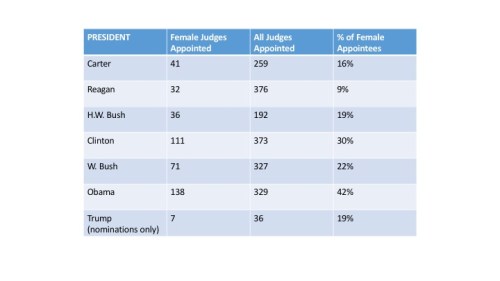
As of August 23, 2017, President Trump has named 36 nominees to Article III courts: 11 to the U.S. Court of Appeals; 24 to the U.S. District Courts; and Justice Neil Gorsuch to the U.S. Supreme Court.  Out of these 36 nominees, only seven are women.  In contrast, by August 2009, President Obama had nominated only 17 nominees, but had named just as many women: seven, including Justice Sonia Sotomayor to the U.S. Supreme Court.

Comparatively, only 19% of President Trump’s judicial nominations are women, a lower percentage than the last three presidents, and comparable with the nominations made by President George H.W. Bush.  The ratio is particularly skewed in nominations to the U.S. District Courts.  Only four out of 24 District Court nominations have gone to women.

Out of the seven female nominees, three replace departing female judges and four replace male judges.  In contrast, six of the male nominees put forward replace female judges.  In other words, with the confirmation of these nominees, for the first time since the Eisenhower Administration, the overall number of active female judges would go down.

It is still early, and the Trump Administration could pick up the pace and appoint more women to the federal bench.  However, the tea leaves are not promising.  Rather, the nominees the Administration have in the works are also, generally, male:

  • DC Circuit – While the Administration was looking at four well-qualified female candidates to fill the vacancy left by Judge Janice Rogers Brown’s retirement, the expected nominee, Deputy White House Counsel Greg Katsas, is male.
  • Second Circuit – The Administration has pitched four candidates to New York Senators Chuck Schumer and Kirsten Gillibrand to fill two 2nd circuit vacancies: all four candidates are male.
  • Third Circuit – The Administration is preparing to nominate Paul Matey to fill one of two vacancies without a nominee.  For the other vacancy, the Administration is mulling David Porter.  Both candidates are male.
  • Fifth Circuit – The Administration is weighing four male candidates for two vacancies on the court.
  • Seventh Circuit – The White House has interviewed three men to replace Judge Ann Claire Williams.
  • Ninth Circuit – The leading candidates for vacancies in Arizona, California, and Oregon are all men.
  • Tenth Circuit – Three male attorneys are being considered for the New Mexico seat vacated by Judge Paul Kelly.
  • Eleventh Circuit – The list of candidates being considered for the vacancy by Judge Frank Hull (a woman), is mostly male, but does include female Georgia Supreme Court Justice Britt Grant.

The Administration and its supporters will argue that this doesn’t matter.  As long as the nominees put forward are qualified, their gender is irrelevant.

While this is true on the individual level, such an argument is based around the erroneous assumption that the only way a female candidate would be chosen over a male one is due to emphasis on diversity.  This is patently false.  Women make up approximately 35% of the legal profession, and this percentage is increasing sharply. Furthermore, the federal bench (the elite of the judiciary) is already one third female.   As such, producing a pool of nominees that is only 19% female suggests an inability to consider qualified female nominees, rather than a slavish devotion to quality.

Since FDR was in office, every single administration appointed a greater percentage of women to the federal bench than the previous administration of their party.  Unless corrective measures are taken, the Trump Administration looks set to break that trend.

Update – I wanted to address a reader inquiry.  The reader in question wanted to know why the relevant barometer for comparison was the percentage of women in the legal profession, rather than the percentage of women in organizations like the Federalist Society, from where Trump draws his appointees.  Three responses.

First, federal judges primarily serve the rule of law and the general public.  As such, it is particularly important that the public maintain faith in the judiciary.  Numerous studies have shown that when female or minority judges are left off the bench, that both the quality and perception of justice suffer.  As such, you judge the diversity of federal judges based on those appearing in court before them.

Second, the Federalist Society does not constitute the entirety of conservative lawyers.  While the membership of the Federalist Society may be predominantly white and male, there are other sources of conservative women.  Furthermore, District Court appointments, where the gender gap is particularly bad, generally do not come from the Federalist Society.  In most cases, the male nominees being chosen are themselves not members of the Federalist Society.  As such, it is difficult to believe that Federalist Society membership is the basis on which female judges are being ignored.

Third and most importantly, the pool of conservative attorneys that Trump is drawing upon for his nominees is essentially the same as the pool tapped by past Republican Presidents.  Over ten years ago, despite women making up only about 25% of the legal community, President Bush managed to have women constitute 22% of his appointees.  Twenty five years ago, President George H.W. Bush essentially matched Trump’s current 19% despite working with a female legal population that was substantially lower than what Trump has now.  When these past presidents, whose nominees were equally conservative, could maintain parity between the percentage of women in their appointments and the percentage of women in the legal community, there is no reason why President Trump cannot do so.