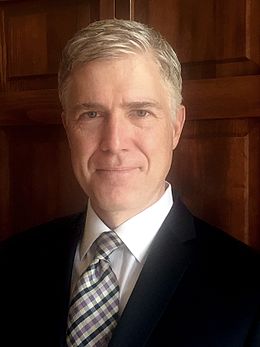
Judge Neil Gorsuch – Nominee to be Associate Justice of the Supreme Court: Part Six – Criminal Procedure

This post is one of a series exploring the background and jurisprudence of Judge Neil Gorsuch.

Much of the question of Judge Neil Gorsuch on the second day of his confirmation hearing focused on his views on separation of powers, civil rights, and constitutional interpretation.  Comparatively little time was spent on Gorsuch’s views on criminal cases.  While we have previously explored Gorsuch’s jurisprudence on the Fourth Amendment, we will now turn to his record on the Fifth and Sixth Amendments.

Fifth Amendment – Prohibition Against Double-Jeopardy

The Double Jeopardy Clause of the Fifth Amendment bars the government from trying an individual twice for the same crime.  Practically, this means that a defendant who has been acquitted of an offense cannot be retried of the same offense.[1]  It also prevents the government from retrying a case that has been dismissed by a judge for lack of evidence.[2]  However, it does not prohibit the government from retrying a defendant where a conviction has been reversed because of a trial error unrelated to guilt or innocence.[3]

For his part, Gorsuch has shown a willingness to strictly enforce the Double Jeopardy Clause.  For example, in one case, Gorsuch overturned the conviction of a man for first degree murder and second degree murder, where the convictions were drawn from the death of the same victim.[4]  In another case, Gorsuch affirmed the dismissal of cumulative federal law punishments under the Assimilative Crime Act.[5] 

Nevertheless, Gorsuch has rejected Double Jeopardy claims in a few cases.  In one case, Gorsuch found that retrying a defendant whose initial conviction had been reversed for ineffective assistance of counsel was not barred by Double Jeopardy.[6]  In another case, he found that trying a defendant for conspiracy in addition to the underlying offense did not violate Double Jeopardy.[7]

Fifth Amendment – Right Against Self-Incrimination

The Fifth Amendment protects individuals from being forced in incriminate themselves in criminal cases.  This principle was applied by the Supreme Court in Miranda v. Arizona in ruling that any statements elicited from witnesses who had not been read their rights could be excluded in subsequent criminal proceedings.[8] 

Gorsuch has generally sided with the government in Fifth Amendment challenges to confessions.  In United States v. Braden, Gorsuch found that a defendant’s waiver of her Miranda rights was not rendered invalid by her intoxication at the time.[9]  Similarly, in another case, Gorsuch rejected a challenge against a prosecutor who had negatively commented on a defendant’s failure to present evidence.[10]

In contrast, in United States v. Benard, where the Tenth Circuit rejected Fifth Amendment challenges in a firearm possession case, Gorsuch dissented.[11]  In dissent, Gorsuch argued that the government had failed to prove that statements admitted in violation of the Fifth Amendment did not affect the defendant’s ultimate conviction.[12]

Sixth Amendment – Right to Counsel

The Sixth Amendment protects our right to counsel during criminal proceedings.  The Supreme Court has held that this right is violated when defense counsel is ineffective.[13]  A counsel’s performance is ineffective when it meets two criteria: it falls below an objective standard of reasonableness (deficient); and it prejudices the defendant (prejudice).[14]

In most of the ineffective assistance of counsel cases he addressed, Gorsuch rejected the claims on the second prong of Strickland, arguing that the deficient performance of defense counsel did not change the outcome of the trial.[15]  In a handful of cases, Gorsuch rejected the claims on the first prong of Strickland, finding that counsel’s performance was not deficient.[16]  In comparison, we were unable to find a single case in which Gorsuch found that a defendant had satisfied both prongs of Strickland and was entitled to a new trial.

Fifth Amendment – Brady Evidence

Under the Supreme Court’s decision in Brady v. Maryland, prosecutors are required to turn over all exculpatory evidence (evidence that could exonerate the defendant) to the defense.[17] In order to be turned over to the defense, evidence must be “material” to either guilt or punishment.

Gorsuch has rejected most of the Brady cases he has addressed on one of three grounds: the materiality of the withheld evidence;[18] the lack of prejudice from the withholding;[19] or the procedural bar of the Brady claim.[20]  However, in one notable case, Gorsuch excoriated prosecutors for failing to disclose emails that would have supported the defendant’s entrapment defense.[21]  While the majority of the Tenth Circuit panel affirmed the conviction in the case, Gorsuch dissented, noting:

“The conviction before us, hanging on the barest of threads and dependant on the omission of exculpatory evidence, is ‘inconsistent with the rudimentary demands of justice.’”[22]

Overall Assessment

The Fifth and Sixth Amendments of the Constitution protect our right to a fair trial.  The presumption of innocence, the bar against double jeopardy, and the right to counsel have worked to ensure that defendants in the American justice system are accorded due process before conviction.  Even in an era where most criminal cases are settled by plea bargaining, these provisions protect defendants who exercise their right to a jury trial.

Gorsuch’s overall record on these issues is mixed.  While he has sometimes shown a willingness to read these provisions strictly, protecting defendant’s rights, he has also shown a tendency to excuse government errors in producing exculpatory documents, and the deficient performance of counsel.  Overall, while he is unlikely to be the champion of criminal procedural rights Justice Scalia was, there is no reason to believe that a Justice Gorsuch would bring a prosecutorial bias to the bench.

This post is one of a series exploring the background and jurisprudence of Judge Neil Gorsuch.


[1] See Evans v. Michigan, 133 S.Ct. 1069, 1074, 185 L.Ed.2d 124 (2013).

[2] See Fong Foo v. United States, 369 U.S. 141, 143, 82 S.Ct. 679, 7 L.Ed.2d 629 (1962) (per curiam).

[3] See Lockhart v. Nelson, 488 U.S. 33, 38, 109 S.Ct. 285, 102 L.Ed.2d 265 (1988).

[4] Wood v. Milyard, 721 F.3d 1190, 1195 (10th Cir. 2013).

[5] United States v. Christie, 717 F.3d 1156, 1172 (10th Cir. 2013).

[6] See United States v. Bergman, 746 F.3d 1128, 1131 (10th Cir. 2014).

[7] See United States v. Mendivil, 208 F. App’x 647, 650 (10th Cir. 2006).

[8] Miranda v. Arizona, 384 U.S. 436, 86 S.Ct. 1602, 16 L.E.2d 694 (1963).

[9] United States v. Braden, 458 F. App’x 751, 753 (10th Cir. 2012).

[10] Matthews v. Workman, 577 F.3d 1175, 1188 (10th Cir. 2009).  See also Littlesun v. Parker, 380 F. App’x 758, 761 (10th Cir. 2010).

[11] United States v. Benard, 680 F.3d 1206, 1215 (10th Cir. 2012) (Gorsuch, J., concurring in part and dissenting in part).

[12] See id.

[13] Strickland v. Washington, 466 U.S. 668, 104 S.Ct. 2052, 80 L.E.2d 674 (1984).

[14] See id.

[15] See, e.g., Chavez v. Franco, 609 F. App’x 527, 528–29 (10th Cir. 2015); United States v. Hendrix, 571 F. App’x 661, 663 (10th Cir. 2014); United States v. Goodwin, 541 F. App’x 851, 853 (10th Cir. 2013); United States v. Summers, 539 F. App’x 877, 880 (10th Cir. 2013); United States v. Diaz, 500 F. App’x 798, 799 (10th Cir. 2012); Jones v. Hartley, 366 F. App’x 964, 965 (10th Cir. 2010); Williams v. Zavaras, No. 09-1518, 2010 WL 653320, at *2 (10th Cir. Feb. 24, 2010).

[16] See, e.g., Wickham v. Friel, 299 F. App’x 813, 817 (10th Cir. 2008); United States v. Cervantes, 267 F. App’x 741, 743–44 (10th Cir. 2008); United States v. Golden, 255 F. App’x 319, 322–23 (10th Cir. 2007); United States v. Mullane, 226 F. App’x 810, 813 (10th Cir. 2007).

[17] Brady v. Maryland, 373 U.S. 83, 83 S.Ct. 1194, 10 L.E.2d 215 (1963).

[18] See, e.g., Banks v. Workman, 692 F.3d 1133, 1144 (10th Cir. 2012).

[19] See, e.g., United States v. Rivera, 478 F. App’x 509, 511 (10th Cir. 2012).

[20] See, e.g., Smith v. Addison, 373 F. App’x 886, 889 (10th Cir. 2010).

[21] United States v. Ford, 550 F.3d 975 (10th Cir. 2008).

[22] Id. at 995 (Gorsuch, J., dissenting) (quoting Brady v. Maryland) (internal quotation marks omitted).

President Trump Announces His First Circuit Court Nomination – Judge Amul R. Thapar

Today, President Trump announced his intent to nominate Judge Amul R. Thapar to a Kentucky seat on the Sixth Circuit Court of Appeals.  Judge Thapar, who was the first Indian-American federal judge upon his confirmation in 2007, is currently serving on the U.S. District Court for the Eastern District of Kentucky.  This is President Trump’s first nomination for a lower court seat.  There are currently over 135 vacancies in the federal judiciary.

Judge Neil Gorsuch – Nominee to be Associate Justice of the Supreme Court: Part Five – Bivens and 1983

This post is one of a series exploring the background and jurisprudence of Judge Neil Gorsuch.

During an interview given over the weekend, Judge Harris Hartz of the Tenth Circuit Court of Appeals, a colleague of Judge Neil Gorsuch, described the latter as respecting “limits on [government] power.”[1]  However, in most cases challenging the deprivation of constitutional rights by the government, Gorsuch has found himself on the government’s side.

42 U.S.C. § 1983 allows individuals whose rights have been violated to sue responsible state officials.[2]  Similar to §1983, the Supreme Court’s decision in Bivens v. Six Unknown Named Agents allows individuals to sue federal actors who have violated their rights under color of law.[3]  Suits under §1983 and Bivens must be relatively circumscribed in scope.  Such actions can only be brought against individual actors, and not against the state in general.[4]  You cannot recover unless the state actor, in depriving your rights, have acted “under color of law.”[5]  In other words, the actions of rogue actors acting outside the law cannot be subject to Bivens or §1983 liability.  Additionally, such actions do not extend to the conduct of private actors contracting with the government.[6]  Even given the rules constraining Bivens and §1983 actions, Gorsuch’s record on such suits stands out as government-friendly.

In his twelve years on the Tenth Circuit, Gorsuch has voted to dismiss Bivens and §1983 cases over 60 times, while only voting to grant in a handful of cases.[7]  In many of these cases, Gorsuch declined to reach the merits of the suits, dismissing for failure to exhaust administrative remedies,[8] failure to plead sufficient facts or connection,[9] and sovereign immunity.[10]

In other cases, Gorsuch has dismissed suits under the doctrine of “qualified immunity.”  Qualified Immunity protects state actors who violate the law in depriving individuals of constitutional rights, provided that the law violated is not “clearly established.”[11]  However, the doctrine has rapidly expanded to protect state actors even in cases where their conduct is clearly unlawful, as long as there is no apposite case expressly forbidding it.[12]  For his part, Gorsuch has invoked qualified immunity broadly, protecting state and federal actors from suit over unlawful conduct.[13] 

In one notable example, Gorsuch found that an officer who fired a taser gun at an individual’s head (against training) was nonetheless entitled to qualified immunity.[14]  In dismissing the suit against him, Gorsuch noted that qualified immunity should “protect from civil liability for damages all officers except the plainly incompetent or those who knowingly violate the law. (internal quotation marks omitted).”[15]  His decision sparked separate opinions by both of his fellow panel members.  In her dissent, Judge Mary Briscoe noted that the application of qualified immunity was a mistake, noting that it was clearly established that “it is excessive to use a Taser to control a target without having any reason to believe that a lesser amount of force—or a verbal command—could not exact compliance.”[16]  In his own concurrence, Judge Scott Matheson noted there was “a constitutional violation in this case”,[17] while agreeing with Gorsuch on the dismissal of the case.

In another case, Judge Carlos Lucero wrote for a Tenth Circuit panel rejecting qualified immunity for police officers who unreasonably delayed a defendant’s arraignment.[18]  Gorsuch dissented from the decision, arguing that, while it is clearly established that the Fourth Amendment protects the right to a timely arraignment, the contours of such a right are not clearly established.[19]

Gorsuch has sided with §1983 plaintiffs in one notable case.  In Browder v. City of Albuquerque, Gorsuch held that an officer who collided with a car while speeding through a red light was not entitled to qualified immunity.[20]  Nevertheless, Gorsuch wrote a concurrence to his own opinion in the case, decrying the use of a §1983 action in the case, and arguing that state tort law would have adequately remedied the plaintiffs.[21]

Looking at Gorsuch’s Bivens and §1983 jurisprudence, it is difficult to see a commitment to check government power.  Rather, the record suggests that Gorsuch sees §1983 as limited to rare and extraordinary circumstances, and that most, if not all, constitutional violations are shielded by qualified immunity.  To be fair to Gorsuch, he is not the only judge to take an expansive view of qualified immunity.[22]  Nevertheless, given the media narrative on Gorsuch’s willingness to limit government power,[23] such a willingness does not extend to individuals whose rights have been wrongly deprived.

This post is one of a series exploring the background and jurisprudence of Judge Neil Gorsuch.


[1] Zoe Tillman, A Federal Judge Offers A Behind-the-Bench Look at Trump’s First Supreme Court Nominee, BuzzfeedNews, Mar. 19, 2017, https://www.buzzfeed.com/zoetillman/judge-offers-a-behind-the-bench-look-at-trumps-supreme?utm_term=.hxbaP7R7py#.lqk2MJ1Jvo (quoting Judge Harris Hartz).

[2] See 42 U.S.C. § 1983 (West) (“Every person who, under color of any statute, ordinance, regulation, custom, or usage, of any State or Territory or the District of Columbia, subjects, or causes to be subjected, any citizen of the United States or other person within the jurisdiction thereof to the deprivation of any rights, privileges, or immunities secured by the Constitution and laws, shall be liable to the party injured in an action at law, suit in equity, or other proper proceeding for redress…”).

[3] Bivens v. Six Unknown Named Agents of Fed. Bureau of Narcotics, 403 U.S. 388, 397, 91 S. Ct. 1999, 2005, 29 L. Ed. 2d 619 (1971).

[4] See, F.D.I.C. v. Meyer, 510 U.S. 471, 472, 114 S. Ct. 996, 999, 127 L. Ed. 2d 308 (1994) (declining to extend Bivens to cover federal agencies).

[5] See West v. Atkins, 487 U.S. 42, 48, 108 S. Ct. 2250, 2254–55, 101 L. Ed. 2d 40 (U.S. 1988) (“To state a claim under § 1983, a plaintiff must allege the violation of a right secured by the Constitution and laws of the United States, and must show that the alleged deprivation was committed by a person acting under color of state law.”).

[6] See Corr. Servs. Corp. v. Malesko, 534 U.S. 61, 63, 122 S. Ct. 515, 517, 151 L. Ed. 2d 456 (2001).

[7] Compare In re Estate of Bleck ex rel. Churchill, 643 F. App’x 754, 757 (10th Cir. 2016) (rejecting excessive force claim brought against police officer) with Riddle v. Hickenlooper, 742 F.3d 922, 930 (10th Cir. 2014) (holding that Colorado’s restrictions on campaign financing violates the Equal Protection Clause).

[8] See Farris v. Frazier, 599 F. App’x 851 (10th Cir. 2015), cert. dismissed, 136 S. Ct. 833, 193 L. Ed. 2d 703 (2016).

[9] See Jones v. Kansas, 572 F. App’x 648, 649 (10th Cir. 2014); Crabtree v. Oklahoma, 564 F. App’x 402, 404 (10th Cir. 2014).

[10] See Johnson v. Oklahoma Dep’t of Transp., 645 F. App’x 765, 768 (10th Cir. 2016).

[11] David French, Another Federal Court of Appeal Attacks the Second Amendment, Nat’l Rev., Mar. 20, 2017, http://www.nationalreview.com/article/445909/andrew-scott-case-second-amendment-attacked-eleventh-circuit-appeals-court.

[12] See id.

[13] See, e.g., Pippin v. Elbert Cty., Colorado, 604 F. App’x 636, 637 (10th Cir. 2015); Hernandez v. Story, 459 F. App’x 697, 698 (10th Cir. 2012); Aragon v. City of Albuquerque, 423 F. App’x 790, 794 (10th Cir. 2011).  

[14] Wilson v. City of Lafayette, 510 F. App’x 775, 780 (10th Cir. 2013).

[15] Id.

[16] Id. at 787 (Briscoe, J., concurring in part and and dissenting in part).

[17] Id. At 792. (Matheson, J., concurring).

[18] Webb v. Thompson, 643 F. App’x 718, 723-24 (10th Cir. 2016).

[19] See id. at 725 (Gorsuch, J., concurring in part and dissenting in part).

[20] See Browder v. City of Albuquerque, 787 F.3d 1076 (10th Cir. 2015).

[21] See id. At 1085 (Gorsuch, J., concurring) (“…there’s little reason to think state courts would fail to fulfill their oaths to see justice done in this case…”).

[22] See White v. Pauly, 580 U.S. __ (2017) (per curiam) (reversing the denial of qualified immunity to officers who entered a home without identifying themselves as police officers and killed the residents who attempted to defend themselves).

[23] See, e.g., Nina Totenberg, Trump’s Supreme Court Nominee Skeptical of Federal Agency Power, Nat’l Pub. Radio, Mar. 17, 2017, http://www.npr.org/2017/03/17/520310365/trumps-supreme-court-nominee-skeptical-of-federal-agency-power.  

Judge Neil Gorsuch – Nominee to be Associate Justice of the Supreme Court: Part Four – Standing

This post is one of a series exploring the background and jurisprudence of Judge Neil Gorsuch.

Today, the Senate Judiciary Committee will begin its consideration of Judge Neil Gorsuch’s nomination to the Supreme Court.  The first day of the hearing will include detailed opening statements by all Senators on the Committee, as well as the individuals introducing the nominee, and Gorsuch himself.[1]  In their statements, Senators will likely reference the U.S. Constitution, the importance of the Supreme Court, and their view on the proper role of a judge.  They may also reference the failed nomination of Judge Merrick Garland, as well as hot-button legal issues, including the constitutional right to privacy, the scope of the Second Amendment, and the government’s ability to regulate money in politics.  However, there is one important legal concept that is unlikely to be addressed: standing.

While standing, and its related doctrines of ripeness and mootness draw little attention in the media, they are nonetheless crucial for litigants.  Article III of the Constitution requires any person filing suit to meet three requirements to have standing to sue.[2]  They must have suffered an “injury in fact,” the injury must be causally connected to the offending conduct, and the injury must be “redressable” by the court.[3]  When these requirements are interpreted narrowly, plaintiffs can find themselves unable to access courts to protect their rights.  When they are interpreted broadly, courts can be overburdened with vexatious litigation.[4]  As such, Gorsuch’s views on standing will have an important impact on access to courts across the country.

Gorsuch’s Record on Standing

Determining Gorsuch’s views on standing is difficult given the relatively few opinions on the subject he has written.  While Gorsuch has voted numerous times to reject plaintiffs’ claims of standing in civil cases, many of these opinions are brief and unpublished.[5]  However, the handful of cases in which Gorsuch analyzes standing suggest that he takes a relatively narrow interpretation of the doctrine.

In re Krause involved a government suit against a Chapter 7 debtor, seeking a tax lien against assets fraudulently hidden in trusts.[6]  Among other claims, Gorsuch rejected a challenge by the debtor’s children to the government action, arguing that they lacked “prudential standing.”[7]  In ruling so, Gorsuch notes that, while the amended bankruptcy code no longer restricts standing to “persons aggrieved” in bankruptcy proceedings, courts can adopt a stricter standard for policy reasons.[8]  Specifically, Gorsuch notes:

“…without such a requirement [of prudential standing], bankruptcy litigation could easily ‘become mired in endless appeals brought by a myriad of parties who are indirectly affected by every bankruptcy court order.’”[9]

In another case, Gorsuch rejected, on standing grounds, a suit against a defendant who engaged in fraudulent financial schemes by the shareholders in an injured corporation; Judge Gorsuch specifically argued that the corporation itself is the only entity given statutory standing by Colorado law.[10]

However, Gorsuch has also found that standing has been met in one notable case.  Writing for a majority of six judges in an en banc case, Gorsuch ruled that Indian tribes who are required to undergo a second round of state permitting before mining on their property have suffered an “injury in fact” sufficient to give them standing.[11]  In his opinion, Gorsuch rejected government arguments to the contrary, stating that a second round of state permitting would impose “additional administrative costs” on the tribes, thereby injuring them.[12]

Gorsuch’s Record on Ripeness and Mootness

The twin doctrines of ripeness and mootness work alongside standing to ensure that federal courts address only “cases and controversies.”.  A case is ripe for judicial review when it is “appropriate for th[e] case to be litigated in federal court by these parties at this time.”[13] Gorsuch has a relatively thin record on addressing ripeness issues.  In United States v. Pope, Gorsuch rejected a Second Amendment challenge to a conviction for possession of a gun brought by the defendant, arguing that the challenge was not ripe for judicial review.[14]  Specifically, Gorsuch noted that “the material facts on which Mr. Pope’s motion to dismiss relies are outside the indictment, hotly disputed by the government, and intimately bound up in the question of Mr. Pope’s guilt or innocence.”[15]  As such, Gorsuch states, the resolution of his claim must wait until the conclusion of the criminal trial.

A case is moot where the court is unable to redress the plaintiff’s injury, even if the injury was redressable when the suit began.[16]  For his part, while Gorsuch has not been hesitant in dismissing cases as moot,[17] he has also been willing to rejected mootness arguments and keep cases alive.  In one case, Gorsuch sided with abortion rights groups challenging a licensing scheme in Oklahoma permitting residents to place a “Choose Life” message on their license plates, while imposing more onerous requirements on pro-choice messages.[18]  In siding with the abortion rights groups, Gorsuch emphasized that the state’s revision of its licensing process to permit pro-choice messages did not “moot” the proceedings, because the process still imposed a viewpoint-based burden.[19]  In another case, Gorsuch held that the parents of a disabled child could bring suit against a school district under the Individuals with Disabilities Education Act (IDEA) and that the suit was not mooted by the child’s aging out of the school system.[20]

Overall Assessment

Over the last thirty years, the Supreme Court has interpreted standing doctrines narrowly, making it more difficult for plaintiffs to find their way into court, while allowing the Court to avoid ruling on the merits of potentially controversial issues.[21]  The Court has also narrowed the use of taxpayer-standing allowing citizens to challenge unconstitutional actions by the government.[22]  So far, there is nothing in Gorsuch’s record suggesting that he would halt or reverse this trend.

Nevertheless, while the standing doctrine isn’t as newsworthy as other issues that the Supreme Court addresses, it is deeply important.  It allows Justices to avoid ruling on the merits of a case, which serves as an important check on judicial power–but also means that plaintiffs are left with no remedy despite claims of injuries or rights violations.  As such, Senators should ask Gorsuch to further flesh out his views on standing.

This post is one of a series exploring the background and jurisprudence of Judge Neil Gorsuch.


[1] Ed Whelan, The Gorsuch Hearing: Nuts and Bolts, Nat’l. Review, Mar. 17, 2017, http://www.nationalreview.com/bench-memos/445871/gorsuch-hearing-logistics.

[2] Lujan v. Defs. of Wildlife, 504 U.S. 555, 560, 112 S. Ct. 2130, 2136, 119 L. Ed. 2d 351 (1992).

[3] Id. at 560-61.

[4] Additionally, some commentators accuse judges of using standing issues to avoid addressing the merits of cases.  See, e.g., Gene Nichol, Rethinking Standing, 72 Cal. L. Rev. 68 (1984). Available at: http://scholarship.law.berkeley.edu/californialawreview/vol72/iss1/2.

[5] See, e.g., Rader v. C.I.R., 616 F. App’x 391 (10th Cir. 2015) (rejecting plaintiff’s standing to appeal for failure to allege any personal or direct injury); Muathe v. Fifth Third Bank, 627 F. App’x 732, 734 (10th Cir. 2015) (rejecting standing where plaintiff only alleges harm to nonparties); Backcountry Hunters & Anglers v. U.S. Forest Serv., 612 F. App’x 934, 935–36 (10th Cir. 2015) (rejecting standing for lack of redressability); DeMillard v. No Named Defendant, 407 F. App’x 332, 333 (10th Cir. 2011) (holding that private citizens do not have standing to demand the prosecution of others); Travis v. Park City Police Dep’t, 277 F. App’x 829, 830 (10th Cir. 2008) (rejecting standing in First Amendment challenge to city ordinance where plaintiff does not have any intention of violating the ordinance); Heller v. Quovadx, Inc., 245 F. App’x 839, 840 (10th Cir. 2007) (rejecting plaintiff’s standing to challenge settlement agreement).  Cf. United States v. Castro, 225 F. App’x 755, 757 (10th Cir. 2007) (rejecting criminal defendant’s standing to challenge search of his ex-girlfriend’s apartment).

[6] In re Krause, 637 F.3d 1160, 1162-63 (10th Cir. 2011)

[7] Id. at 1168.

[8] Id.

[9] Id. 

[10] Niemi v. Lasshofer, 728 F.3d 1252, 1261 (10th Cir. 2013).

[11] Hydro Res., Inc. v. U.S. E.P.A., 608 F.3d 1131, 1144-45 (10th Cir. 2010).

[12] Id. at 1145.

[13] Nat’l Advert. Co. v. City of Miami, 402 F.3d 1335, 1339 (11th Cir. 2005).

[14] United States v. Pope, 613 F.3d 1255, 1258 (10th Cir. 2010).

[15] Id. at 1257.

[16] Shawnee Tribe v. United States, 423 F.3d 1204, 1212 (10th Cir. 2005).

[17] See, e.g., Wyoming v. U.S. Dep’t of Interior, 587 F.3d 1245, 1247 (10th Cir. 2009) (“Because no such questions remain in this case, we dismiss this appeal as moot, vacate the judgment of the district court, and remand with instructions to dismiss the case for lack of subject matter jurisdiction.”).

[18] Hill v. Kemp, 478 F.3d 1236, 1243 (10th Cir. 2007).

[19] Id. (“[The state’s action] does not diminish the fact that a difference arguably preferring one competing viewpoint over another remains bedded in Oklahoma law.”).

[20] Garcia v. Bd. of Educ. of Albuquerque Pub. Sch., 520 F.3d 1116, 1123 (10th Cir. 2008).

[21] See, e.g., Hollingsworth v. Perry, 570 U.S. __, 133 S. Ct. 2652 (2013) (holding that proponents of ballot measure lacked standing from the measure’s defeat in federal court and, as such, could not appeal the decision).  See also Clapper v. Amnesty Int’l, 568 U.S. __ (2013) (holding that Amnesty International does not have standing to challenge provisions of the Foreign Intelligence Surveillance Act).

[22] See Hein v. Freedom From Religion Found., 551 U.S. 587 (2007) (holding that taxpayers did not have standing to challenge unconstitutional expenditures made by the Executive Branch).

Judge Neil Gorsuch – Nominee to be Associate Justice of the Supreme Court: Part Three – Religious Liberty

This post is one of a series exploring the background and jurisprudence of Judge Neil Gorsuch.

“Religious Freedom” is the buzzword of the season.  Both state legislatures[1] and the Trump Administration[2] are moving to outline protections for “freedom of conscience,” even when such protections impede other government mandates.  Such measures, if passed, will likely face court challenges, and may, ultimately, be reviewed by the Supreme Court.  As such, Judge Neil Gorsuch, if confirmed, will help define the contours of our religious rights.

Given Gorsuch’s open religiosity,[3] his views on religious rights have drawn significant media attention and speculation.[4]  Some argue that Gorsuch’s faith would lead him to broad readings of religious liberty rights, particularly in cases where the exercise of such rights clash with anti-discrimination mandates.[5]  Others note his membership in a fairly liberal congregation and come to the opposite conclusion.[6]  While Gorsuch has written extensively on issues of ethics and morality off the bench,[7] he has relatively few decisions on religious freedom and liberty to his name.  Looking at this small universe of cases, we find that Gorsuch takes a broad view of religious liberty, and, if confirmed, would likely be a champion for expanding the right to “freedom of conscience.”

Protecting “Religious Freedom” Supersedes Other Governmental Interests

Perhaps no opinion of Gorsuch’s elucidates his view of religious liberty as clearly as his opinion in Hobby Lobby Stores Inc. v. Sebelius.[8]  Hobby Lobby involved a challenge to the contraceptive-coverage requirement under the Affordable Care Act.[9]  The plaintiffs, the Greens, the owners of a for-profit corporation, maintained religious objections to providing coverage for four FDA-approved contraceptive devices, and sued to strike down the mandate.[10]  After the District Court denied an injunction, the Tenth Circuit, in an unusual move, decided to hear the case as an en banc court.[11]  A divided court narrowly found for Hobby Lobby, ruling both that for-profit corporations maintained religious rights,[12]  and that the Religious Freedom Restoration Act (RFRA) exempted them from the mandate.[13] 

Gorsuch concurred with the decision, writing separately on the related issue of the Anti-Injunction Act.[14]  Gorsuch’s opinion, nevertheless, included a powerful defense of the Greens’ claim, and of the expansiveness of RFRA.  In his opinion, Gorsuch described the Greens as unpopular religious minorities who need the protection of RFRA.[15]  Requiring them to provide contraceptive coverage, he noted, would be requiring them to be complicit in wrongdoing.[16] 

Gorsuch also laid out an expansive interpretation of RFRA, stating:

“Congress structured RFRA to override other legal mandates, including its own statutes, if and when they encroach on religious liberty.”[17] 

RLUIPA’s Mandates Do Not Require Accommodation of All Religious Needs

Alongside RFRA, the Religious Land Use and Institutionalized Persons Act (RLUIPA) extends a higher standard of scrutiny to regulations that interfere with the religious freedom of state prisoners.[18]  In interpreting RLUIPA, Gorsuch has not taken the broad view of religious liberty that he elucidated in Hobby Lobby.  Rather, his views have been more mixed.  While Gorsuch has defended religious freedom rights for prisoners, he has also shown a willingness to reject RLUIPA claims.

Gorsuch has rejected most of the RLUIPA appeals he has heard with fairly little discussion of the scope of the statute and the rights it affords.[19]  However, he does elaborate on his understanding of RLUIPA in Abdulhaseeb v. Calbone.  Abdulhaseeb involved a challenge to prison policy that denied a Muslim inmate a halal diet.  The Tenth Circuit reversed a lower court ruling dismissing the prisoner’s RLUIPA claims.[20]  In concurring with the majority opinion, Gorsuch emphasized the limited nature of the court’s decision and RLUIPA’s mandate.[21]  RLUIPA, Gorsuch noted, applies in cases where prison officials are essentially starving the prisoner by denying him any food that he can eat.[22]  However, lesser deprivations of religious liberty, such as the denying of meals that fall short of complete deprivation may not necessarily fall afoul of RLUIPA.[23]

At the same time, Gorsuch laid out a powerful affirmation of the religious rights of prisoners in Yellowbear v. Lambert.  Mr. Yellowbear, a member of the Northern Arapahoe tribe, sought access to the prison sweat lodge for religious exercises.[24]  The prison refused, citing security concerns, and the Tenth Circuit, in an opinion by Gorsuch, reversed.[25] 

Gorsuch begins his opinion with a paean to the religious rights of prisoners:

“While those convicted of crime in our society lawfully forfeit a great many civil liberties, Congress has (repeatedly) instructed that the sincere exercise of religion should not be among them…”[26]

Gorsuch goes on to criticize efforts by judges to parse religious beliefs and exercises.[27]  Instead, he notes that RLUIPA authorizes only an inquiry into the sincerity of religious beliefs, not into their importance or significance.[28]  In so finding, Gorsuch rules that the prison must accommodate Mr. Yellowbear’s religious beliefs.

The Establishment Clause Does Not Bar Government Displays of Religion

Gorsuch’s jurisprudence also suggests that he does not consider the Establishment Clause to set up a “wall of separation” between church and state.  Instead, Gorsuch takes an originalist view of the Establishment Clause, turning to understandings of church-state separation from the time of the founding of the Constitution.  Gorsuch has further elucidated this view through a number of dissents from denials of en banc rehearing involving cases where the Tenth Circuit struck down government displays of religious artifacts.  In 2008, Gorsuch dissented from denial of en banc in a decision striking down the display of the Ten Commandments.[29] In dissent, he argued that “displays of the decalogue alongside other markers of our nation’s legal and cultural history do not threaten an establishment of religion.”[30] 

Similarly, in 2010, Gorsuch was one of four dissenters from the Tenth Circuit’s decision not to rehear en banc a ruling striking down the display of memorial crosses on public roadsides.[31]  In that case, Gorsuch joined a broader dissent by Judge Paul Kelly,[32] as well as dissenting separately.[33]

Overall Assessment

In his 11 years on the federal bench, Gorsuch has participated in less than fifteen cases involving the Religion Clauses, RFRA, or RLUIPA.  Through these cases, however, Gorsuch has displayed his respect for religious belief, and a commitment to protect it against government regulation.  In cases such as Hobby Lobby and Yellowbear, Gorsuch has written aggressively against government impediments to religious exercise.  Furthermore, Gorsuch has also decried interpretations of the Establishment Clause that take religion out of the public sphere.  As such, Christians who are concerned that their beliefs may be under attack will find comfort in his decisions.

However, it must be noted that Gorsuch does not limit his use of “religious liberty” to Christians alone.  His writings make it clear that even minority religions deserve the protections of RFRA, RLUIPA, and the Free Exercise Clause.  As such, Gorsuch’s opinions could presumably be used to protect the Muslim student seeking to wear a hijab in their place of employment, a Sikh soldier’s right to serve wearing a turban, and a Hindu child’s right to have meat-free alternatives in school.

Nevertheless, Gorsuch’s broad interpretation of RFRA should concern minority groups, including African Americans, and the LGBT community, who have faced religious discrimination.  Taken to the logical extreme, such a broad reading of religious liberty could be used as a “sword” to avoid complying with anti-discrimination laws.  In other words, a businessperson could use their religious beliefs to justify only hiring men in the workplace, or refusing to serve interracial couples at a restaurant, or declining to offer spousal benefits to same-sex couples.  Such an understanding of RFRA could cripple efforts at civil rights enforcement.

Additionally, with both state legislatures and the administration pushing to allow “religious liberty” exemptions to anti-discrimination mandates, judges will likely be called upon to decide cases where both parties claim violations of religious liberty.  For example, in a case involving a Christian employer who seeks to prevent a Muslim employee from praying, arguing that such prayer violates their own faith, it is unclear whose religious rights would triumph.  Gorsuch’s relatively limited jurisprudence on these issues does not yield an answer on his own approach to such a question.

Overall, Gorsuch looks set to lead a significant expansion of the scope of “religious liberty.”  It will be up to the Senate Judiciary Committee to dialogue with Gorsuch to determine the nature and implications of such an expansion.

This post is one of a series exploring the background and jurisprudence of Judge Neil Gorsuch.


[1] Laura Sydell, LGBTQ Advocates Fear ‘Religious Freedom’ Bills Moving Forward in States, Nat’l Pub. Radio, Feb. 26, 2017, http://www.npr.org/2017/02/26/515585721/lgbtq-advocates-fear-religious-freedom-bills-moving-forward-in-states.

[2] Michelangelo Singorile, Trump Transition Official: ‘Religious Freedom’ Order is Still Coming, Huffington Post, Feb. 26, 2017, http://www.huffingtonpost.com/entry/ken-blackwell-religious-freedom-order_us_58b2f87ee4b0a8a9b7830c3e.

[3] Transcript: Neil Gorsuch’s Remarks After Accepting the U.S. Supreme Court Nomination, Denver Post, Jan. 31, 2017, http://www.denverpost.com/2017/01/31/neil-gorsuch-full-remarks-supreme-court-nomination/ (“I am so thankful tonight for my family, my friends and my faith”).

[4] See, e.g., Kimberly Winston, 5 Faith Facts on Trump’s Supreme Court pick, Neil Gorsuch, Deseret News, Feb. 1, 2017, http://www.deseretnews.com/article/865672369/5-faith-facts-on-Trump7s-Supreme-Court-pick-Neil-Gorsuch.html.

[5] See Kate Shellnut, Trump’s Supreme Court Pick: Religious Freedom Defender Neil Gorsuch, Christianity Today, Jan. 31, 2017, http://www.christianitytoday.com/gleanings/2017/january/trump-nominates-neil-gorsuch-supreme-court.html.

[6] See Julie Zauzmer, Neil Gorsuch Belongs to a Notably Liberal Church – and would be the First Protestant on the Court in Years, Wash. Post, Feb. 1, 2017, https://www.washingtonpost.com/news/acts-of-faith/wp/2017/02/01/neil-gorsuch-belongs-to-a-notably-liberal-church-and-would-be-the-first-protestant-on-the-court-in-years/?utm_term=.dd1615233993.

[7] For example, the morality of assisted suicide.

[8] See, e.g., Mark K. Matthews and John Frank, What Neil Gorsuch’s Faith and Writings Could Say About His Approach to Religion on the Supreme Court, The Denver Post, Feb. 10, 2017, http://www.denverpost.com/2017/02/10/neil-gorsuch-religion/; Steve Vladeck, Hobby Lobby and Executive Power: Gorsuch’s Key Rulings, CNN, Feb. 1, 2017, http://www.cnn.com/2017/01/31/politics/hobby-lobby-executive-power-gorsuch-key-rulings/; Tribune News Services, Hobby Lobby Case Among Supreme Court Nominee Neil Gorsuch’s Notable Opinions, Chicago Tribune, Jan. 31, 2017, http://www.chicagotribune.com/news/nationworld/politics/ct-supreme-court-nominee-neil-gorsuch-notable-opinions-20170131-story.html; Carrie Johnson, Who is Neil Gorsuch, Trump’s First Pick for the Supreme Court, Nat’l Pub. Radio, Jan. 31, 2017, http://www.npr.org/2017/01/31/511850519/who-is-neil-gorsuch-trumps-first-pick-for-the-supreme-court; Christina Cauterucci, What Neil Gorsuch, Trump’s SCOTUS Pick Means For American Women, Slate, Jan. 31, 2017, http://www.slate.com/blogs/xx_factor/2017/01/31/what_neil_gorsuch_trump_s_scotus_pick_means_for_american_women.html.  

[9]Hobby Lobby Stores, Inc. v. Sebelius, 723 F.3d 1114, 1125 (10th Cir. 2013) (en banc).

[10] Id. at 1124-25.

[11] Id at 1125.

[12] Id. at 1137.

[13] Id. at 1145.

[14] Id. at 1152 (Gorsuch, J., concurring).

[15] Id. at 1152-53 (“[RFRA] doesn’t just apply to protect popular religious beliefs; it does perhaps its most important work in protecting unpopular religious beliefs, vindicating this nation’s long-held aspiration to serve a refuge of religious tolerance.”).

[16] Id. at 1152 (“As they understand it, ordering their companies to provide insurance coverage for drugs and devices whose use is inconsistent with their faith itself violates their faith, representing a degree of complicity their faith disallows.”).

[17] Id. at 1156.

[18] Religious Land Use and Institutionalized Persons Act, Pub. L. 106-274, codified at 42 U.S.C. § 2000cc et. seq.

[19] See Ali v. Wingert, 569 Fed. Appx. 562 (10th Cir. 2014) (rejecting RLUIPA challenge to rule requiring prisoners to use their committed name alongside their religious name); Ciempa v. Jones, 511 Fed. Appx. 781 (10th Cir. 2013) (rejecting RLUIPA claim for failure to exhaust administrative remedies); Zapata v. Brandenberg, 291 Fed. Appx. 450 (10th Cir. 2008) (rejecting RLUIPA claim where prisoner was allegedly removed from faith-based program for refusing to convert).  See also Ali v. Province, 550 Fed. Appx. 619 (10th Cir. 2013) (rejecting First Amendment challenge by Muslim inmate).

[20] Abdulhaseeb v. Calbone, 600 F.3d 1301, 1320 (10th Cir. 2010).

[21] Id. at 1326 (“Whether and to what extent the statute goes further [than the facts of this case] is a question for another day.”).

[22] Id. at 1325

[23] Id. (“It is surely a burden to forgo an occasional meal.  But it’s not a substantial burden, and RLUIPA proscribes only government actions that substantially burden religious exercise.”) (emphasis in original).

[24] Yellowbear v. Lambert, 741 F.3d 48, 53 (10th Cir. 2014).

[25] See id.

[26] Id. at 52.

[27] Id. at 54 (“Just as civil courts lack any warrant to decide the truth of a religion…we also lack the license to decide the relative value of a particular exercise of religion.”).

[28] Id.

[29] Green v. Haskell Cnty. Bd. of Comm’rs, 574 F.3d 1235 (10th Cir. 2008).

[30] Id. at 1244 (Gorsuch, J., dissenting from denial).

[31] American Atheists, Inc. v. Davenport, 637 F.3d 1095, 1101 (10th Cir. 2010) (noting that Judges Gorsuch, Kelly, Tymkovich, and O’Brien voted to grant en banc rehearing).

[32] Id. (Kelly, J., dissenting).

[33] Id. at 1108 (Gorsuch, J., dissenting).

Judge Neil Gorsuch: Nominee to be Associate Justice of the Supreme Court: Part Two – Fourth Amendment Jurisprudence

This post is one of a series exploring the background and jurisprudence of Judge Neil Gorsuch.

Studying Fourth Amendment cases in which Judge Neil Gorsuch has authored a majority opinion, a concurrence, or a dissent, it is my conclusion that Gorsuch enacts a highly disciplined approach to this area of law.  His opinions scrupulously guard the rights of unsympathetic defendants, exhaustively examine the whole corpus of American law to gain an understanding of each case, and go out of their way to ensure that every defendant enjoys the legal protections to which they are entitled at law.  This essay will examine some of the cases I reviewed in arriving at this conclusion.

In U.S. v Carloss, police officers entered the curtilage of the defendant’s home, without a warrant, to conduct a knock and talk, a common police method designed to discover evidence of illegal conduct while talking with whomever answers the door.  In doing so, the officers walked onto the front step of the home, passing numerous “No Trespassing” signs.  Judge David Ebel, writing for the panel majority, found no Fourth Amendment violation from the police “knock and talk.”[1]  Gorsuch wrote a lengthy dissent, turning to common law at the “the founding” to illustrate why he found this search unreasonable.

In this dissent, Gorsuch noted that the government relied on two theories to support their position.  First, the government “suggest[ed] that its officers enjoy an irrevocable right to enter a home’s curtilage to conduct a knock and talk . . . arguing that . . . the knock and talk is an investigative technique approved by the Supreme Court.”[2]  Alternatively, they argued that police possess only a revocable right to walk onto the front step and knock on the door, and that “a homeowner may avoid a knock and talk only by hiding in the home and refusing to answer the door.”[3]

Gorsuch disagreed with both these stances, explaining that “an officer’s leave to gather information is sharply circumscribed when he steps off those thoroughfares and enters the Fourth Amendment’s protected areas,” and that “[t]he founders understood, too, that a search of a constitutionally protected space generally qualifies as unreasonable when undertaken without a warrant, consent, or an emergency.”[4]

Judge Gorsuch then, in a nod to his originalist leanings, noted that “the common law at the time of the founding did not require a property owner to express his intent to revoke a license to enter in any particular way. Indeed, all that was traditionally required were express words … or … an act … indicating an intention to revoke.”[5]  Judge Gorsuch summed up his Carloss dissent with the following words: “Our duty of fidelity to the law requires us to respect all these law enforcement tools. But it also requires us to respect the ancient rights of the people when law enforcement exceeds their limits. In this case the two arguments the government offers to justify its conduct can claim no basis in our constitutional tradition.”[6]

Other cases reveal a similar fealty to the Fourth Amendment’s original intent. In U.S. v. Krueger, Judge Gorsuch concurred with an opinion rejecting the validity of a warrant issued across jurisdictional boundaries.[7]  In U.S. v Ackerman, Judge Gorsuch held that the National Center for Missing and Exploited Children acted as an agent of the government in searching Mr. Ackerman’s effects without a warrant, and that their search of a suspected child pornographer violated his constitutional rights.[8]  In both cases, Judge Gorsuch demonstrated adherence to the law in favor of unsympathetic defendants.

Additionally, in other criminal cases, Gorsuch has shown the capacity to restrain executive overreach.  In U.S. v Cos, Gorsuch dissented from a panel decision affirming the grant of a suppression motion, arguing that the government’s appeal of the motion was untimely.[9]  Specifically, Gorsuch argued that the government should be required to follow the same rules of timely filing as a habeas petitioner.[10]  In U.S. v Games-Perez, Gorsuch criticized circuit precedent preventing a defendant who was not aware of his felon status from presenting a mens rea defense.[11] 

Perhaps no case better illustrates Gorsuch’s skepticism of prosecutorial overreach than his opinion in U.S. v. Rentz.  Rentz involved a question of whether 18 U.S.C. § 924(c)(1)(A) (which prohibits carrying a firearm during a drug-related or violent offence) allows multiple charges from the single use of a firearm.  Gorsuch answered this question in the negative, rebuking government prosecutors for employing syntactical errors to dramatically increase the number of separate charges they could press against a defendant for the single discharge of a firearm.[12]

Gorsuch interpreted the statute using “plain old grade school grammar, [while] the government’s contrary interpretation require[d] some sophisticated syntactical somersaults,”[13] piling on additional charges without proving any further uses, carries, or possessions.  Gorsuch accused the government of myopically focusing on the statute’s adverbial phrases “without even a stolen glance at the verbs those phrases modify.”[14]

Many liberals oppose the nomination of Gorsuch to be on the Supreme Court on various grounds, including skepticism about his willingness to stand up to executive power.  However, taken as a body, Gorsuch’s writings indicate that he will not hesitate to restrain the Executive, defend the Fourth Amendment, and rigorously protect the rights of the accused.

This post is one of a series exploring the background and jurisprudence of Judge Neil Gorsuch.


[1] US v Carloss, 818 F. 3d 988, 999 (10th Cir, 2016).

[2] Id. at 1004.

[3] Id.

[4] Id. at 1007.

[5] Id. at 1004-05.

[6] Id. at 1015.

[7] U.S. v. Krueger, 809 F.3d 1109, 1117-18 (10th Cir. 2015).

[8] U.S. v. Ackerman, 831 F.3d 1292, 1295 (10th Cir. 2016).

[9] U.S. v. Cos, 498 F.3d 1115, 1137 (10th Cir. 2007).

[10] See id.

[11] U.S. v. Games-Perez, 667 F.3d 1136, 1143 (10th Cir. 2012).

[12] U.S. v. Rentz, 777 F.3d 1105, 1110-11 (10th Cir. 2015) (en banc).

[13] Id. 

[14] Id.

Judge Neil Gorsuch – Nominee to be Associate Justice of the Supreme Court: Part One – Background

This post is one of a series exploring the background and jurisprudence of Judge Neil Gorsuch.

On May 18, 2016, when Donald Trump released his first list of potential Supreme Court nominees, there was a notable omission: Tenth Circuit judge Neil Gorsuch.[1]  The omission signaled that Trump was different than previous Presidents: focused on “out of the beltway” candidates and unimpressed by Ivy League credentials.[2]

Of course, last week, Trump chose Gorsuch for the nomination, bypassing Judge Thomas Hardiman, who worked as a taxi driver to pay for law school, and Judge William Pryor, who dedicated his entire life to government service.  In his announcement speech, Trump emphasized Gorsuch’s intelligence and qualifications, while downplaying the nominee’s privileged background.  Nevertheless, to understand the kind of justice Gorsuch will be, it is necessary to look not just at his judicial record, but at his legal career before he took the bench.

Childhood and Education

Neil McGill Gorsuch was born in Denver, Colorado on Aug. 29, 1967.  Gorsuch’s mother, Anne Gorsuch Burford, was a prominent Colorado Republican who served in the legislature in the mid-1970s.  In 1981, Burford was confirmed to serve as President-elect Reagan’s EPA Administrator.[3]  Gorsuch moved to D.C. with his mother shortly after and grew up in the Beltway, attending Georgetown Preparatory School.  He went on to Columbia University and attended Harvard Law School on a Truman scholarship.  While at Harvard, Gorsuch served as a summer associate in a number of prominent law firms, including Davis, Graham & Stubbs, Cravath, Swaine & Moore, and Sullivan & Cromwell.

Legal Career

After graduation, Gorsuch clerked for conservative Judge David Sentelle on the U.S. Court of Appeals for the D.C. Circuit.  He went on to Supreme Court clerkships with Justices Byron White and Anthony Kennedy.  After his clerkships, Gorsuch spent ten years in the Washington D.C. office of Kellogg, Huber, Hansen, Todd, Evans & Figel (“Kellogg”), the last seven as a partner.  During this time, Gorsuch also attended University College, Oxford, getting a Doctorate of Philosophy for his research on assisted suicide and euthanasia.

At Kellogg, Gorsuch participated in several prominent contracts, RICO, and securities cases.  In 2002, Gorsuch led his client, Conwood, to the then largest private damages award in antitrust litigation, securing a $1.05 billion judgment against United States Tobacco Company.[4]  Furthermore, Gorsuch was one of the lead attorneys in two cases that secured the rights of dissenting class members to appeal the approval of a class action settlement.[5]

During his time at Kellogg, Gorsuch occasionally penned articles on legal issues.  In 2004, he published an article exploring the legality of assisted suicide.[6]  In Feb. 2005, Gorsuch wrote for the National Review, opining that liberal activists were using the courts to move on policy issues that they were unable to win in the political sphere.[7]

In 2005, Gorsuch was hired to be Principal Deputy to Assistant Attorney General Robert McCallum.  In that role, he helped manage the work of the Department of Justice, focused on the Antitrust, Civil, Civil Rights, Environment, and Tax Divisions.  In this role, Gorsuch reviewed briefs, decided which cases should be filed and settled, and implemented various civil justice initiatives.

Nomination and Confirmation

On May 10, 2006, Gorsuch was nominated by President George W. Bush for a Colorado seat on the Tenth Circuit Court of Appeals.  Gorsuch received a cursory hearing on June 21, 2006, with only Senator Lindsay Graham present from the committee.[8]  While Gorsuch was questioned about his writings on assisted suicide,[9] there was no objection to his nomination in committee.  Gorsuch was confirmed by the Senate in a voice vote without opposition on July 20, 2006, a mere two months after his nomination.

Shortly after his confirmation, Gorsuch’s first book, The Future of Assisted Suicide and Euthanasia, was published by Princeton University Press.[10]  The book elaborates on Gorsuch’s previous writings, laying out his opposition to the legalization of physician assisted suicide.[11]  Specifically, Gorsuch criticizes the arguments in support of assisted suicide and argues that the intentional ending of human life is morally wrong.[12]

Drawing Conclusions

It is stating the obvious to note that, as a white male, Judge Gorsuch does not add gender or racial diversity to the Supreme Court.  However, what is more notable is that Judge Gorsuch’s experience and credentials are very similar to that of another justice serving on the court: Chief Justice John Roberts.  Gorsuch, like Roberts, is a graduate of Harvard Law School.  Roberts and Gorsuch both spent much of their careers in Big-law practice, with short stints in the federal government.  Additionally, Gorsuch, like Roberts, spent most of his professional life in Washington D.C., only moving to Colorado upon his confirmation to the Tenth Circuit.

However, unlike Roberts, who endured a long, protracted confirmation, Gorsuch was confirmed with hardly any debate or fanfare.  Despite his conservative credentials,[13] and his youth, Gorsuch found support from every single Democrat in the Senate.  The two months from nomination to confirmation for Gorsuch is particularly astounding given the extended delays many later nominees faced.  While some of this is attributable to a less contentious time in confirmation politics, another factor is the relatively slim paper trail the nominee then possessed.  Other than a handful of law review articles and editorials, most focused on assisted suicide, Gorsuch had published little, and as such, had said little to attract opposition.

This will not be the case for his current confirmation.  Gorsuch has ten years of opinions for critics to dig through to find objectionable material.  Nevertheless, Gorsuch’s corporate background, and smooth confirmation to the Tenth Circuit speaks to his likely elevation, and suggests that, as a justice, he would be a conservative in Roberts’ mold.

This post is one of a series exploring the background and jurisprudence of Judge Neil Gorsuch.


[1] Jenna Johnson and Robert Barnes, Trump Releases List of 11 Judges He’d Consider Nominating to Supreme Court, Wash. Post, May 18, 2016, https://www.washingtonpost.com/politics/trump-releases-list-of-11-judges-hed-consider-nominating-to-supreme-court/2016/05/18/8ed0e14e-1d25-11e6-b6e0-c53b7ef63b45_story.html?utm_term=.c3874559cf24.

[2] Id. (quoting Jonathan H. Adler).

[3] Patricia Sullivan, Anne Gorsuch Burford, 62, Dies: Reagan EPA Director, Wash. Post, July 22, 2004, http://www.washingtonpost.com/wp-dyn/articles/A3418-2004Jul21.html.

[4] Conwood v. UST, No. 5:98-CV 00108 (W.D.Ky), 290 F.3d 768 (6th Cir. 2002), cert. denied 537 U.S. 1148 (2003).

[5] See Devlin v. Scardelletti, 536 U.S. 1 (2002); Cal. Pub. Employees’ Retirement Syst. v. Felzen, 525 U.S. 215 (1999).

[6] Neil Gorsuch, The Legalization of Assisted Suicide and the Law of Unintended Consequences, 2004 Wis. Law Rev. 1347 (2004).

[7] Neil Gorsuch, Liberals and Lawsuits, National Review Online, Feb. 2005.

[8] Confirmation Hearings on Federal Appointments Before the S. Comm. on the Judiciary, 109th Cong. Serial No. J-109-4 (2006).

[9] See id. (Questions from Sen. Ron Wyden to Neil Gorsuch).

[10] Mike Norton, Gorsuch is a Solid Conservative Pick for the Supreme Court, The Hill, Jan. 31, 2017, http://thehill.com/blogs/pundits-blog/the-judiciary/317015-gorsuch-is-a-solid-conservative-pick-for-the-supreme-court.

[11] Neil Gorsuch, The Future of Assisted Suicide and Euthanasia (Princeton University Press 2006) (2009).

[12] Id.

[13] Confirmation Hearings on Federal Appointments Before the S. Comm. on the Judiciary, 109th Cong. Serial No. J-109-4 (2006) (statement for the record of Sen. Patrick Leahy) (calling Gorsuch “very conservative”).

A President’s Most Enduring Legacy

This past Friday, President Trump signed an Executive Order suspending immigration from seven Muslim-majority countries.  Around 9:00 PM Saturday, federal judge Ann Donnelly blocked much of the order.  Judge Donnelly’s decision sparked a furious backlash among Trump supporters, some of whom temporarily rewrote her Wikipedia page, calling her an Islamist sympathizer.  However, more importantly, the order, along with three others issued shortly after, gave a lifeline to lawful immigrants left stranded.  It was a stark reminder of how important judges can be.

The President’s ability to appoint federal judges is one of his most enduring powers.  Years after he leaves office, the judges President Trump has appointed will continue to hear cases and influence the law.  For example, Judge Andrew Hanen, appointed by President George W. Bush, halted President Obama’s DAPA program in 2015.  Similarly, Donnelly, appointed by Obama, was able to stay President Trump’s orders.

None of this makes judges political actors.  Rather, lifetime appointments serve to insulate federal judges from political pressure and allow them to make unpopular decisions.  In 1957, Judge Ronald Davies refused to order federal troops out of Arkansas, allowing them to desegregate Little Rock schools.  In 2015, Judge Callie Granade struck down Alabama’s ban on same-sex marriage.  History is replete with such examples of federal judges standing up for the Constitution, even when political pressures dictate otherwise.

In less than twelve hours, President Trump will announce his nominee to serve as Associate Justice for the Supreme Court.  It will be the first of hundreds of names he will send to the Senate to fill judicial vacancies across the country.  Once confirmed, these judges will reshape the law over the next three decades.  It is essential that Trump names judges whose fealty is to the Constitution and the rule of law, rather than to a political party or figure.  It is equally important for citizens to follow the process and weigh in.  After all, if there is a takeaway from the last three days, it is that judges matter.   

Supreme Court Shortlist: Judge Bill Pryor

Two weeks ago, Judge Bill Pryor was the ideal choice to replace Justice Scalia.  Pryor, a judge on the Eleventh Circuit Court of Appeals, had a deeply conservative record on the bench.  Furthermore, he was the protege of Alabama Senator Jeff Sessions, President Trump’s nominee to be U.S. Attorney General.  However, in the last two weeks, Pryor’s chances have faded under attacks from both the left,[1] and the right.[2]  Nevertheless, Pryor has been on Trump’s radar for a long time,[3] and as such, a Pryor nomination cannot be discounted.

Background

William Holcombe Pryor Jr. was born in Mobile, Alabama on Apr. 26, 1962.  Growing up in a Catholic family, Pryor attended Northeast Louisiana University and Tulane University Law School, serving as editor in chief of the Tulane Law Review.  After graduating, Pryor clerked for Fifth Circuit Judge John Minor Wisdom, a civil rights icon.

In 1994, Jeff Sessions, a former judicial nominee himself, was elected to be the first Republican Attorney General of Alabama since reconstruction.  Sessions hired Pryor to be his deputy.  Upon Sessions’ election as a U.S. Senator in 1996, the 34-year-old Pryor became Alabama’s 46th Attorney General.  In 1998, Pryor won election to the position in his own right, narrowly defeating Alabama Supreme Court Justice Terry Butts.  Pryor was subsequently re-elected in 2002 by a wider margin.

In 2001, Alabama Supreme Court Chief Justice Roy Moore unveiled a 5280 lb granite monument to the Ten Commandments at the Supreme Court building.[4]  In response to a lawsuit alleging a violation of the separation of church and state, Judge Myron Thompson ordered the monument to be removed.[5]  After an appeal affirmed, Moore announced his intention to ignore Judge Thompson’s ruling.[6]  The monument was eventually removed after Moore’s colleagues overruled his decision.[7]  Pryor, the Attorney General of Alabama at the time, filed ethics charges against Moore, arguing that his failure to follow the court order violated his oath of office.[8]  Pryor’s prosecution led to Moore’s removal from his position.[9]

On April 9, 2003, Pryor was nominated by President George W. Bush for an Alabama seat on the Eleventh Circuit Court of Appeals.  Pryor’s nomination attracted fierce opposition from liberal groups.[10]  During his confirmation hearing, Pryor was criticized for stating that the Supreme Court’s decision in Roe v. Wade was “an abomination” because it “led to a morally wrong result.”[11]  Pryor was also attacked for filing equating consensual same-sex intimacy with prostitution, adultery, necrophilia, bestiality, incest, and pedophilia.[12]  Due to Pryor’s refusal to disavow his previous statements, Democrats blocked his confirmation through the 108th Congress.

On Feb. 20, 2004, President Bush unilaterally appointed Pryor to the Eleventh Circuit using a recess appointment, which would allow Pryor to serve until the end of 2005.[13]  The Eleventh Circuit dismissed a court challenge to Pryor’s recess appointment.[14] 

Despite the reelection of President Bush and a diminished Democratic Senate minority, Democrats continued to block Pryor’s confirmation.  On May 23, 2005, a bipartisan group of 14 Senators announced a deal that would let Pryor and two other nominees get an up-or-down vote.  Pryor was confirmed by a small 53-45 margin, with 3 Republican Senators opposing his confirmation.

Jurisprudence

In his twelve years on the federal bench, Pryor has authored more than 300 majority opinions (and many more concurrences and dissents).  A review of these opinions confirms his reputation as a firmly conservative jurist.

Frequent Dismissals on Jurisdiction, Standing, and Mootness Grounds

For a dispute to properly be in federal court, the court must have jurisdiction over the subject matter of the case, the parties must have standing to bring suit, and the case must not be moot.  These requirements ensure that federal courts are only addressing disputes that they can actually remedy.  Pryor’s opinions interpret these requirements very stringently, frequently dismissing cases for lack of jurisdiction,[15] standing,[16] or as moot.[17]

In one notable case, Pryor wrote for a District Court panel in holding that Democratic state legislators in Alabama lacked standing to challenge racial gerrymandering.[18]  This opinion was overturned by the U.S. Supreme Court, who held that Pryor’s opinion violated “elementary principles of procedural fairness.”[19]

Narrow Interpretation of Criminal Procedural Protections

The American criminal justice system relies on the principle that the accused is presumed innocent until proven guilty.  This principle is enforced through the protections of the Fourth, Fifth, and Sixth Amendments.  Pryor, however, has interpreted these protections narrowly.

For example, Pryor has repeatedly upheld searches and seizures from Fourth Amendment challenges.[20]  In Castillo v. U.S., Pryor upheld a warrantless search of a defendant enrolled in a pretrial diversion program.[21]  Specifically, Pryor noted, as a matter of first impression, that such searches only needed to be justified by reasonable suspicion, not probable cause.[22]  Judge Robreno, sitting by designation, disagreed on this point, noting that the defendant “cannot be considered commensurate with a probationer or parolee on the continuum of Fourth Amendment rights.”[23]  In another case, Pryor reversed a district court ruling that a border patrol agent lacked reasonable suspicion in stopping a vehicle.[24]  Pryor’s opinion sparked a dissent from Judge Rosemary Barkett, noting that the ruling ignores the standard of review and “presents the facts in the light most favorable to the government, cobbling together select portions of the testimony to support its own conclusion.”[25]

Similarly, Pryor has held that admitting hearsay evidence against death penalty defendants does not violate their rights under the Confrontation Clause,[26] that airport screenings are a reasonable administrative search,[27] and that defense counsel’s failure to investigate a claim of juror misconduct is not ineffective assistance of counsel.[28]  Each of these opinions sparked a spirited dissent.[29]

Frequent Affirmance of Convictions

Pryor has rejected challenges to convictions that allege insufficiency of the evidence,[30] improper statements by the prosecutors,[31] improper jury instructions,[32] and the erroneous admission of evidence.[33]  He has proven equally skeptical to challenges to harsh sentences.[34]   

Pryor has been particularly deferential to state courts when facing challenges to state convictions under habeas review.[35]  While the Anti-Terrorism and Effective Death Penalty Act (AEDPA) requires deference to state court decisions unless they are “unreasonable applications” of federal law, Pryor has been willing to defer to state courts even where his colleagues disagree.  For example, Pryor affirmed the denial of habeas relief to a prisoner who was convicted after a police detective falsely testified at his trial.[36]  In another case, Pryor denied habeas relief to a defendant whose attorney had failed to present mitigating evidence at his death penalty hearing.[37]

In contrast, Pryor has shown a willingness to reverse sentences that he considers too low,[38] and to reverse grants of a new trial for defendant.[39] 

Prominent Reversals

Consistent with the record of most court of appeals judges, a small number of Pryor’s opinions have been reversed or criticized by the en banc Eleventh Circuit, or the Supreme Court.

Substantive Reversals by the Supreme Court

CSX Transp., Inc. v. State Bd. of Equalization – This case involved a suit by a railroad challenging the tax valuation of its property.  In a 2-1 decision, Pryor held that the Railroad Revitalization and Regulatory Reform Act (4-R Act) does not allow railroads to bring federal suits challenging state tax evaluations.[40]  The Supreme Court granted certiorari and reversed in a unanimous decision by Chief Justice Roberts.[41]  Roberts found that the 4-R Act’s text was clear and contradicted Pryor’s interpretation.[42]

Alabama Legislative Black Caucus v. Alabama – This case involved a challenge to Alabama’s state legislative districts, brought by black lawmakers.  The suit alleged that the districts were drawn with a racial purpose, diluted the vote of African-American voters, and as such, constituted impermissible racial gerrymanders.  Pryor rejected all the challenges, upholding the districts over the dissent of Judge Myron Thompson.[43]  The Supreme Court reversed in a 5-4 opinion by Justice Breyer.[44]  In his opinion, Justice Breyer found Pryor’s conclusions to be “legally erroneous.”[45]

Summary Reversals by the Supreme Court

U.S. v. Smith – In this case, Pryor held that, under the Armed Career Criminal Act, a conviction for fleeing and eluding a law enforcement officer constituted a “violent” felony.[46]  The Supreme Court summarily reversed Pryor’s decision,[47] and remanded it to be reevaluated in light of Johnson v. U.S., an opinion by Justice Scalia that struck down the residual clause of the Armed Career Criminal Act.[48]

Hunter v. U.S. – In this case, Pryor rejected challenges to a criminal defendant who was erroneously sentenced as an armed career criminal.[49]  The Supreme Court summarily reversed Pryor’s decision.[50]

Reversals by the en banc Eleventh Circuit

Wilson v. Warden – This case involved a prisoner, Wilson, challenging his death sentence under federal habeas review.  Wilson argued that his attorney was deficient in failing to present mitigation evidence at his sentencing hearing.  Pryor rejected the appeal, holding that the Georgia Supreme Court’s one-sentence dismissal of Wilson’s case was not an unreasonable application of federal law under AEDPA.[51]  The Eleventh Circuit granted en banc rehearing, vacating the panel opinion, and, in an opinion by Pryor, held that federal courts were not obligated to “look through” state court opinions to examine their reasoning in habeas cases.[52]  This decision sparked two strong dissents, each joined by five judges on the court.  Judge Adalberto Jordan dissented, noting that Pryor’s decision ignored both Eleventh Circuit precedent and contrary decisions by sister circuits.[53]  Judge Jill Pryor also dissented, stating that the majority opinion “runs roughshod over the principles of federalism.”[54]

Overall Assessment

Perhaps more than any other nominee on Trump’s shortlist, Pryor attracts opposition.  Liberal groups object to his aggressive criticisms of Roe,[55] his deeply conservative record on the bench,[56] and his outspokenness in support of conservative politics.[57]  At the same time, Pryor has been attacked by conservative groups for his prosecution of Roy Moore.[58]  With Senate Majority Leader Mitch McConnell ruling out revoking the minority’s ability to filibuster Supreme Court nominees,[59] and with at least one Republican Senator on record previously opposing Pryor’s confirmation,[60] Pryor’s confirmation seems extremely unlikely.

Nevertheless, if confirmed, Pryor would add a strong new conservative voice to the Supreme Court.  Pryor’s willingness to defer to police and prosecutors would move the court rightward on criminal justice issues.  Furthermore, Pryor would likely continue the trend of construing standing and jurisdiction narrowly, making it more difficult to bring disputes in federal court.  Moreover, Pryor’s willingness to stand up to Moore, and his record on the Eleventh Circuit,[61] suggest that he would continue Justice Scalia’s tradition of the principled dissent, writing with the intent of influencing future trends in the law rather than attracting support from his colleagues.

Pryor is no stranger to grueling confirmation struggles, having survived two to become an appellate judge.  However, his nomination to the Supreme Court would likely spark a fight that would dwarf previous clashes.  If the Trump administration nominates him, it’ll be because he is, by their standards, worth the battle.


[1] Mark Joseph Stern, The One SCOTUS Nominee Democrats Should Stop at Any Cost, Slate, Jan. 25, 2017, http://www.slate.com/articles/news_and_politics/jurisprudence/2017/01/william_pryor_has_no_place_on_the_supreme_court.html.

[2] J. Peppar Bryars, Conservatives Must Scrutinize Bill Pryor’s Record, AL.com, Jan. 23, 2017, http://www.al.com/opinion/index.ssf/2017/01/conservatives_must_scrutinize.html.

[3] Gabriel Roth, Donald Trump Just Proposed Diane Sykes and Bill Pryor for the Supreme Court: Who are They, Slate, Feb. 13, 2016, http://www.slate.com/blogs/the_slatest/2016/02/13/donald_trump_just_proposed_diane_sykes_and_bill_pryor_for_the_supreme_court.html.

[4] Kent Faulk, Roy Moore Timeline: Ten Commandments to Gay Marriage Stance, AL.com, May 6, 2016, http://www.al.com/news/birmingham/index.ssf/2016/05/roy_moore_timeline_ten_command.html.   

[5] Glassroth v. Moore, 229 F. Supp. 2d 1290 (M.D. Al. 2002).

[6] Supra n. 4.

[7] Id.

[8] Law Center, Ten Commandments Judge Removed From Office, CNN.com, Nov. 14, 2003, http://www.cnn.com/2003/LAW/11/13/moore.tencommandments/ (quoting William Pryor) (“At the end of the day, when the courts resolve those controversies, we respect their decision”).

[9] Id.

[10] See, e.g., Ralph G. Neas, Report of People For The American Way In Opposition to the Confirmation of William H. Pryor, Jr. to the United States Court of Appeals for the Eleventh Circuit, June 10, 2003, http://files.pfaw.org/uploads/2017/01/william-pryor-report.pdf.

[11] Confirmation Hearings on Federal Appointments Before the S. Comm. on the Judiciary, 108th Cong. Serial No. J-108-15 (2003) (Questions from Sen. Arlen Specter to William H. Pryor).

[12] Id. (Questions from Sen. Russ Feingold to William H. Pryor).

[13] Law Center, Bush Uses Recess Appointment to Put Nominee on Court, CNN.com, Feb. 20, 2004, http://www.cnn.com/2004/LAW/02/20/bush.pryor/.

[14] Evans v. Stephens, 387 F.3d 1220, 1222 (11th Cir. 2004).

[15] See Nicklaw v. Citimortgage, Inc., 839 F.3d 998, 1000 (11th Cir. 2016); Tundidor v. Miami–Dade Cty., 831 F.3d 1328, 1330 (11th Cir. 2016) (dismissing for lack of admiralty jurisdiction); Carmouche v. Tamborlee Mgmt., Inc., 789 F.3d 1201, 1202 (11th Cir. 2015); Leslie v. Hancock Cty. Bd. of Educ., 720 F.3d 1338, 1342 (11th Cir. 2013); Chao Lin v. U.S. Atty. Gen., 677 F.3d 1043, 1044 (11th Cir. 2012); Swann v. Sec’y, Georgia, 668 F.3d 1285, 1286 (11th Cir. 2012); Thomas v. Blue Cross & Blue Shield Ass’n, 594 F.3d 823, 826 (11th Cir. 2010); Thomas v. Blue Cross & Blue Shield Ass’n, 594 F.3d 814, 816 (11th Cir. 2010); Dial v. Healthspring of Alabama, Inc., 541 F.3d 1044, 1046 (11th Cir. 2008).

[16] See Miccosukee Tribe of Indians of Florida v. United States, 698 F.3d 1326, 1328–29 (11th Cir. 2012); Hollywood Mobile Estates Ltd. v. Seminole Tribe of Florida, 641 F.3d 1259, 1262 (11th Cir. 2011); CAMP Legal Def. Fund, Inc. v. City of Atlanta, 451 F.3d 1257, 1264 (11th Cir. 2006); Tanner Advert. Grp., L.L.C. v. Fayette Cty., GA, 451 F.3d 777, 780 (11th Cir. 2006).

[17] See San Francisco Residence Club, Inc. v. 7027 Old Madison Pike, LLC, 583 F.3d 750, 752 (11th Cir. 2009); Tanner Advert. Grp., L.L.C. v. Fayette Cty., GA, 451 F.3d 777, 780 (11th Cir. 2006).

[18] Alabama Legislative Black Caucus v. Alabama, 989 F. Supp. 2d 1227, 1237 (M.D. Ala. 2013), judgment entered, No. 2:12-CV-1081, 2013 WL 6913115 (M.D. Ala. Dec. 20, 2013), and vacated and remanded, 135 S. Ct. 1257, 191 L. Ed. 2d 314 (2015).

[19] Alabama Legislative Black Caucus v. Alabama, 135 S. Ct. 1257, 1269, 191 L. Ed. 2d 314 (2015).

[20] See United States v. Phillips, 834 F.3d 1176, 1178 (11th Cir. 2016); United States v. LaFond, 783 F.3d 1216, 1219 (11th Cir.), cert. denied sub nom. Widdison v. United States, 136 S. Ct. 213, 193 L. Ed. 2d 163 (2015) (holding that the constitutional prohibition against shackling does not apply during sentencing hearings); United States v. Hollis, 780 F.3d 1064, 1066–67 (11th Cir.), cert. denied, 136 S. Ct. 274, 193 L. Ed. 2d 200 (2015) (applying the “plain view” exception to admit evidence); United States v. Barber, 777 F.3d 1303, 1304 (11th Cir. 2015) (finding that the driver of a car had “apparent authority” to consent to the search of defendant’s bag); United States v. Johnson, 777 F.3d 1270, 1272 (11th Cir.), cert. denied, 136 S. Ct. 178, 193 L. Ed. 2d 143 (2015); Case v. Eslinger, 555 F.3d 1317, 1322 (11th Cir. 2009); United States v. Clay, 483 F.3d 739, 743 (11th Cir. 2007).

[21] Castillo v. United States, 816 F.3d 1300, 1302 (11th Cir. 2016).

[22] Id. at 1304.

[23] Id. at 1308 (Robreno, J., dissenting).

[24] United States v. Bautista-Silva, 567 F.3d 1266, 1268 (11th Cir. 2009).

[25] Id. at 1275 (Barkett, J., dissenting).

[26] Muhammad v. Sec’y, Florida Dep’t of Corr., 733 F.3d 1065, 1067 (11th Cir. 2013).

[27] Corbett v. Transp. Sec. Admin., 767 F.3d 1171, 1174 (11th Cir. 2014).

[28] Henry v. Warden, Georgia Diagnostic Prison, 750 F.3d 1226, 1228 (11th Cir. 2014).

[29] See Corbett, 767 F.3d at 1184 (Martin, J., dissenting); Henry, 750 F.3d at 1233 (Wilson, J., dissenting); Muhammad, 733 F.3d at 1081-82 (Wilson, J., concurring in part and dissenting in part).

[30] See United States v. Sammour, 816 F.3d 1328, 1331 (11th Cir.), cert. denied, 137 S. Ct. 177, 196 L. Ed. 2d 146 (2016); United States v. Toll, 804 F.3d 1344, 1349 (11th Cir. 2015); United States v. Creel, 783 F.3d 1357, 1358 (11th Cir. 2015); United States v. Merrill, 685 F.3d 1002, 1005 (11th Cir. 2012); United States v. Rodriguez, 628 F.3d 1258, 1260 (11th Cir. 2010); United States v. Spoerke, 568 F.3d 1236, 1240–41 (11th Cir. 2009); United States v. Straub, 508 F.3d 1003, 1006 (11th Cir. 2007).

[31] See, e.g., United States v. Demarest, 570 F.3d 1232, 1235 (11th Cir. 2009).

[32] See United States v. Dortch, 696 F.3d 1104, 1107 (11th Cir. 2012); Jamerson v. Sec’y for Dep’t of Corr., 410 F.3d 682, 684 (11th Cir. 2005).

[33] See United States v. Frediani, 790 F.3d 1196, 1197–98 (11th Cir. 2015).

[34] See United States v. Osorio-Moreno, 814 F.3d 1282, 1284 (11th Cir. 2016) (rejecting a challenge to a sentence at the statutory maximum); United States v. Smith, 775 F.3d 1262, 1264 (11th Cir. 2014) (holding that drug crimes without the element of mens rea can be “serious drug crimes”).

[35] See, e.g., De Lisi v. Crosby, 402 F.3d 1294, 1297 (11th Cir. 2005) (reversing grant of habeas by district court judge). See also Patterson v. Sec’y, Florida Dep’t of Corr., 812 F.3d 885, 896 (11th Cir.) (Pryor, J., dissenting) (“Ace Patterson—a child rapist, kidnapper, and burglar—won the habeas lottery today”), reh’g en banc granted, opinion vacated, 836 F.3d 1358 (11th Cir. 2016), and cert. dismissed sub nom. Jones v. Patterson, 137 S. Ct. 28, 195 L. Ed. 2d 900 (2016). 

[36] Stephens v. Hall, 407 F.3d 1195, 1199 (11th Cir. 2005).

[37] Ponticelli v. Sec’y, Florida Dep’t of Corr., 690 F.3d 1271, 1276 (11th Cir. 2012).

[38] See United States v. Whatley, 719 F.3d 1206, 1208 (11th Cir. 2013); United States v. Foley, 508 F.3d 627, 631 (11th Cir. 2007).

[39] United States v. Almanzar, 634 F.3d 1214, 1217 (11th Cir. 2011).

[40] CSX Transp., Inc. v. State Bd. of Equalization, 472 F.3d 1281, 1283 (11th Cir. 2006). 

[41] CSX Transp., Inc. v. Georgia State Bd. of Equalization, 552 U.S. 9, 128 S. Ct. 467, 169 L. Ed. 2d 418 (2007).

[42] See id. at 19 (“We decline to find distinctions in the statute where they do not exist, especially where, as here, those distinctions would thwart the law’s operation”).

[43] Alabama Legislative Black Caucus v. Alabama, 989 F. Supp. 2d 1227, 1237 (M.D. Ala. 2013), judgment entered, No. 2:12-CV-1081, 2013 WL 6913115 (M.D. Ala. Dec. 20, 2013), and vacated and remanded, 135 S. Ct. 1257, 191 L. Ed. 2d 314 (2015).

[44] Alabama Legislative Black Caucus v. Alabama, 135 S. Ct. 1257, 191 L. Ed. 2d 314 (2015).

[45] Id. at 1268.

[46] United States v. Smith, 742 F.3d 949, 951 (11th Cir. 2014), cert. granted, judgment vacated, 135 S. Ct. 2935, 192 L. Ed. 2d 961 (2015).

[47] Smith v. United States, 135 S. Ct. 2935 (2015).

[48] Johnson v. United States, 135 S. Ct. 2551 (2015).

[49] Hunter v. United States, 559 F.3d 1188, 1190 (11th Cir. 2009), cert. granted, judgment vacated, 558 U.S. 1143, 130 S. Ct. 1135, 175 L. Ed. 2d 967 (2010).

[50] Hunter v. United States, 558 U.S. 1143, 130 S. Ct. 1135, 175 L. Ed. 2d 967 (2010).

[51] Wilson v. Warden, Georgia Diagnostic Prison, 774 F.3d 671, 674 (11th Cir. 2014), reh’g en banc granted, opinion vacated (July 30, 2015), on reh’g en banc, 834 F.3d 1227 (11th Cir. 2016).

[52] Wilson v. Warden, Georgia Diagnostic Prison, 834 F.3d 1227, 1230 (11th Cir. 2016) (en banc).

[53] See id. at 1245 (Jordan, J., dissenting) (“There should be strong reasons for creating a circuit split, and I do not see any such reasons here”).

[54] Id. at 1247 (Pryor, J., dissenting).

[55] See, Ralph G. Neas, Report of People For The American Way In Opposition to the Confirmation of William H. Pryor, Jr. to the United States Court of Appeals for the Eleventh Circuit, June 10, 2003, http://files.pfaw.org/uploads/2017/01/william-pryor-report.pdf.

[56] Ian Millhiser, Meet the Two Ultra-Conservatives Trump Would Nominate to the Supreme Court, ThinkProgress, Feb. 19, 2016, https://thinkprogress.org/meet-the-two-ultra-conservatives-trump-would-nominate-to-the-supreme-court-da6a78b686b6#.lzs57vyi9.

[57] Mark Joseph Stern, The One SCOTUS Nominee Democrats Should Stop at Any Cost, Slate, Jan. 25, 2017, http://www.slate.com/articles/news_and_politics/jurisprudence/2017/01/william_pryor_has_no_place_on_the_supreme_court.html.

[59] Alexander Bolton and Bob Cusack, McConnell All But Rules Out Filibuster Change, The Hill, Jan. 27, 2017, http://thehill.com/homenews/senate/316583-mcconnell-all-but-rules-out-filibuster-change.

[60] Sen. Susan Collins (R-ME) voted against Pryor’s elevation to the Eleventh Circuit.

[61] Approximately 1 in 5 Pryor opinions have sparked a concurrence or dissent, higher than most other appellate judges.

Supreme Court Shortlist: Judge Diane Sykes

Judge Diane Sykes can be considered the ostensible frontrunner for the Supreme Court seat vacated by Justice Scalia.  Sykes has extensive judicial experience, having been a judge continuously since 1992.  Furthermore, she is strongly conservative, with a long affiliation with the Federalist Society and the Republican party.  Because of these credentials, Judge Sykes has been considered for a Supreme Court nomination by numerous Republican presidential candidates.  While President-elect Trump hasn’t indicated who he will nominate to the Supreme Court vacancy, it is inevitable that Judge Sykes will be seriously considered.

Background

Diane Sykes (nee Schwerm) is a Wisconsin native, born in Milwaukee on Dec. 23, 1957.  Sykes studied journalism at Northwestern University, marrying fellow journalist Charlie Sykes shortly after graduating.[2]  Sykes went on to Marquette University Law School and a clerkship for Judge Terence Evans on the U.S. District Court for the Eastern District of Wisconsin.[3]  Following her clerkship, Sykes worked as a civil litigator at Whyte Hirschboek for seven years before her 1992 election to a seat on the Milwaukee County Circuit Court.

As a trial court judge, Sykes developed a reputation as a conservative jurist and a strict sentencer.  During her tenure, a number of her decisions were overturned by the Wisconsin Court of Appeals.  In one case, Sykes ruled that a defense attorney who instructed his client to lie on the stand was not ineffective.  This ruling was overturned by the higher court, who noted that it violated “the overwhelming weight of legal authority.”[4]  In another case, she was criticized for remarks from the bench that indicated a bias towards the prosecution.[5]

In 1999, Sykes was chosen by Republican Governor Tommy Thompson to replace Justice Donald Steinmetz on the Wisconsin Supreme Court.[6]  While the selection was generally praised, it also invited criticism from State Senator Gary George, who characterized Sykes as a jurist supported by “the right wing of the Republican party”.[7]  In 2000, Sykes won election to the Supreme Court in her own right by campaigning as a strict constructionist with law enforcement support.[8]  The campaign, while generally low-key, attracted some attention due to Sykes’ ex-husband Charlie’s aggressive advocacy on behalf of his wife.[9]

As a Wisconsin Supreme Court Justice, Sykes built a record of conservative jurisprudence, voting frequently in support of law enforcement, prosecutors, and civil defendants.[10]  For example, in one case, Sykes wrote in dissent that a defendant’s right to due process is not violated where one of his jurors indicates his inability to understand the English language, absent any showing of prejudice from the trial court.[11]  In another case, Sykes dissented in support of preserving a lease with a term that was expressly prohibited by statutory language.[12]  In her opinions, Sykes expressed support for conservative ideas of jurisprudence, including textualism.[13]

On November 14, 2003, Sykes was nominated by President George W. Bush for a seat on the Seventh Circuit Court of Appeals.  Sykes’ nomination was supported by Wisconsin’s then-Senators Herb Kohl and Russ Feingold, both Democrats and members of the Senate Judiciary Committee.[14]  Nevertheless, the majority of Senate Democrats opposed Sykes’ confirmation, citing her conservative record as a Wisconsin state judge.  Specifically, Sen. Durbin noted Sykes’ gratuitous comments while sentencing two anti-abortion protesters who blocked access to an abortion clinic.  While noting that blocking access to the clinic was illegal, Sykes went on to praise the defendants, calling them “exemplary citizens” and stating that she respected them for having “the courage of [their] convictions.”[15]  Such statements were contrasted with Sykes’ tendency to berate other defendants as a sentencing judge.[16]  Despite these concerns, Sykes was confirmed on June 24, 2004 by a vote of 70-27, with 21 Democrats supporting her confirmation.[17]  She took her seat on the Seventh Circuit on July 1, 2004.

Jurisprudence

In her twelve years on the federal bench, Sykes has authored nearly 700 majority opinions (and many more concurrences and dissents).  A review of these opinions establishes certain patterns in her jurisprudence.

Narrow View of Criminal Procedural Protections

The Fourth, Fifth, and Sixth Amendments provide important structural protections to individuals charged with crimes, and threatened with imprisonment.  Sykes has interpreted these protections narrowly, rarely applying sanctions such as the exclusionary rule against overreaching police and prosecutors.

For example, Sykes has generally rejected Fourth Amendment challenges to warrantless searches,[18] and seizures.[19]  In United States v. Freeman, Sykes found that the police were justified in conducting a warrantless arrest of a suspect, and in strip searching him prior to booking.[20] 

In comparison, Sykes has only applied the exclusionary rule to suppress evidence in a handful of cases.[21]  In U.S. v. Stotler, for example, Sykes dissented from a panel decision holding that police officers had probable cause to search an arrestee’s truck.[22]

In cases involving the Fifth Amendment’s protection against self-incrimination, Sykes has rejected challenges to allegedly coercive police interrogations.[23]  Sykes has been equally skeptical of claims under the Sixth Amendment right to counsel.[24]

Broad Interpretation of Some First Amendment Rights and Protections

In contrast to her relatively narrow interpretation of the Fourth, Fifth, and Sixth Amendments, Sykes has interpreted the First Amendment broadly to protect political activity from government scrutiny and regulation.  In 2011, Sykes struck down Wisconsin’s cap on contributions to political action committees.[25]  Sykes also struck down Illinois’ ballot access requirements for independent candidates, ruling that they violated the First and Fourteenth Amendments.[26]  In addition, Sykes noted that the use of mandatory bar dues to pay for a public image campaign likely violates the First Amendment rights of Wisconsin attorneys.[27]

On the religion clauses, Sykes notably authored the opinion ruling that for-profit corporations had religious rights, and that requiring them to provide contraception coverage for their employees violated these rights,[28] an opinion that drew a fierce dissent from Judge Ilana Rovner.[29]  Sykes’ reasoning was narrowly upheld by the Supreme Court in a 5-4 decision.[30]  Sykes also dissented in support of the religious rights of a church that was denied a permit to move its location.[31]  In contrast, Sykes has taken a relatively narrow interpretation of Establishment Clause rights.  While she did join six of her colleagues in ruling that holding high school graduation ceremonies in an evangelical church violates the First Amendment,[32] she rejected a First Amendment challenge to the display of the Ten Commandments at a public building.[33]  Similarly, she dissented from an opinion authored by Judge Posner, arguing that taxpayers could not sue for monetary relief when the federal government violates the Establishment Clause.[34]

Willingness to Allow Plaintiffs to Overcome Pleading Barriers

On the civil side, Sykes has occasionally reversed district court judges for dismissing suits at the pleading stage, indicating a willingness to allow plaintiffs to present civil cases.  Notably, she has reversed judges both on judgments on the pleadings,[35] and on grants of summary judgment.[36]  She has similarly been skeptical of dismissing cases based on statute of limitations defenses.[37]   

Two exceptions to this pattern are Sykes’ willingness to dismiss cases based on lack of standing,[38] and claim preclusion.[39]  For example, Sykes was the only judge in an en banc evaluation of a class action claim to find that the case should be dismissed for lack of standing.[40]

Skepticism to Civil Rights and Title VII claims

Sykes’ record also shows a tendency to rule against civil rights, labor, and discrimination plaintiffs.  For example, Sykes has repeatedly rejected constitutional claims for police misconduct,[41] and violation of rights in prison.[42]  In one case, Sykes dismissed a suit against a police officer who withheld key pieces of information from a warrant application, holding that, while the officer should have known that withholding material information was against the law, it was unclear if the information withheld in this case was material.[43]  In another case, Sykes dissented from an opinion by Judge Kenneth Ripple, who held that a prisoner could sue a warden who failed to protect him from attacks by other inmates.[44]

Similarly, Sykes has been skeptical of sex discrimination claims,[45] racial discrimination claims,[46] and claims under the Americans with Disabilities Act (ADA).[47]  Sykes notably dissented from an order permitting a pro se litigant to proceed with her ADA claim, arguing that her brief was inadequate under Rule 28 of the Federal Rules of Appellate Procedure.[48]

Prominent Reversals

Consistent with the record of most court of appeals judges, a very small number of Sykes’ opinions have been reversed or criticized by subsequent panels, the en banc Seventh Circuit, or the Supreme Court.  Not all of these reversals indicate criticism of Sykes’ reasoning.  In some of the cases, the law had evolved after her initial ruling.

Summary Reversals by the Supreme Court

U.S. v. Fish – In one of her first published opinions as a Seventh Circuit judge, Sykes held that in cases where trial judges choose not to depart downward on a sentence, those decisions are not reviewable on appeal.[49]  The Supreme Court summarily reversed Sykes’ decision, and remanded it to be re-evaluated in light of United States v. Booker.[50]

Frederick v. Holder – In this opinion, Sykes dismissed claims for statutory and constitutional relief from the petitioner in a removal proceeding.[51]  Specifically, Sykes rejected claims that the petitioner was eligible to remain in this country as a lawful permanent resident, and that the removal proceedings violated his equal protection and due process rights.[52]  The Supreme Court summarily reversed Sykes’ opinion,[53] remanding it with instructions to review in light of Judulang v. Holder.

Reversals by the en banc Seventh Circuit

U.S. v. Skoien – In 2006, Skoien was convicted of domestic battery in Wisconsin, and placed on probation, a condition of which was that he would not own a firearm.  In 2007, Skoein was arrested for using a deer hunting shotgun that belonged to his father.  Skoein argued that prohibiting him from lawfully using a firearm violated the Second Amendment’s right to bear arms.  While the trial judge rejected his argument by arguing that criminals essentially forfeit their Second Amendment rights, a 3-judge panel of the Seventh Circuit, in an opinion written by Sykes, reversed.[54]  In her opinion, Sykes ruled that there could be no blanket forfeiture of Second Amendment rights, and as such, the constitutionality of the restriction must be evaluated under intermediate scrutiny.[55]  The full Circuit, meeting en banc, reversed Sykes, holding that categorical prohibitions on firearm ownership were consistent with the Second Amendment.[56]  Sykes was the only dissenter from this decision.

Empress Casino Joliet Corp. v. Blagojevich – The plaintiffs in this case were operators of riverboat casinos.  They brought suit against the former Governor of Illinois, his campaign finance committee, and Illinois racetracks, alleging violations of the Racketeer Influenced and Corrupt Organizations Act (RICO) and state-law constructive trust claims.  The plaintiffs sought to halt all distribution of state subsidies to Illinois racetracks.  The district court held that the Tax Injunction Act barred a judge’s ability to halt the subsidies and place the money in escrow.  In a 2-1 decision, Sykes reversed the court, holding that the Tax Injunction Act did not bar his jurisdiction to impose a constructive trust for the subsidies.[57]  The full en banc court overruled the panel in an opinion by Judge Richard Posner.[58]  Posner, who had dissented from the panel decision, ruled that the district court correctly found the Tax Injunction Act to be a barrier to a judge’s ability to enjoin the Illinois state subsidy program.  Sykes dissented from the ruling, joined by Judges Bauer and Kanne.

Minn-Chem, Inc. v. Agrium, Inc. – The plaintiffs and defendants in this case were potash producers.  The plaintiffs alleged price fixing and other anti-competitive behaviors by the defendants, and filed suit under the Sherman Act.  After the district court denied a motion to dismiss for failure to state a claim, the Seventh Circuit, in an opinion written by Sykes, reversed,[59] relying on a prior Seventh Circuit en banc case, United Phosporus, Ltd. v. Angus Chem. Co.[60]  The full Seventh Circuit unanimously reversed the panel and overruled United Phosporus.[61]

U.S. v. Spears – Spears was convicted of five felonies based on his business producing counterfeit identity documents.  He appealed three of his convictions: aggravated identity theft, producing a false identification document, and unlawful possession of five or more false identification documents.  The panel, led by Sykes, affirmed two of his convictions, but reversed the one for unlawful possession.[62]  The full court granted en banc reconsideration, and affirmed Sykes’ rulings on two of the convictions.[63]  However, it overturned Spears’ conviction for aggravated identity theft, holding that Spears’ provision of false identification papers to others only constituted identity fraud and not identity theft.

Reversals by Subsequent Panels

U.S. v. Baldwin – In another early opinion, Sykes ruled that a defendant cannot challenge a concurrent sentence under an indictment that was one day late.[64]  Specifically, Sykes noted that the concurrent conviction would not have added any time to the defendant’s sentence, and as such, the only penalty he faces for the error is a de minimis $100 ‘special assessment.’[65]  Two years later, Judge Sykes herself wrote an opinion overruling Baldwin and the precedent it relied on, holding that such multiplicitous punishment constituted error.[66]

U.S. v. Newbern – Sykes wrote for the panel, holding that the Illinois crime of “reckless discharge of a firearm” constitutes a crime of violence under the sentencing guidelines.[67]  The next year, Newbern was overturned by another panel of the Seventh Circuit based on the Supreme Court’s decision in Begay v. United States, which had held the contrary.[68]

Andrews v. CBOCS W., Inc. – Andrews, a white server at a Cracker Barrel restaurant, brought suit under Title VII and the Age Discrimination in Employment Act (ADEA), alleging that her black manager fired her based on her race and age.  In her opinion affirming the dismissal of the case, Sykes laid out the evidentiary burden on the plaintiff in discrimination cases, noting that the burden is different based on whether the evidence offered is direct or indirect.[69]  Two years later, another panel of the Seventh Circuit overruled Andrews and its progeny, holding that direct and indirect evidence cannot be subjected to different legal standards, and that rather, all evidence should be evaluated holistically.[70]

Speeches and Panel Discussions

As noted above, Sykes has maintained a longstanding affiliation with the Federalist Society, an organization of conservative legal professionals seeking to mold the law in accordance with principles of textualism and originalism.  Thus, Sykes has spoken at several Federalist Society events about theories of legal interpretation.

On Dec. 12, 2012, Sykes participated in a discussion on Judge J. Harvie Wilkinson’s book, Cosmic Constitutional Theory, in Indianapolis.[71]  During the discussion, moderated by Indiana Solicitor General Thomas Fisher, Sykes voiced her general agreement with the central thesis of the book: that courts need to take a restrained approach to evaluating law.  However, Sykes went on to note that deference to the legislature on all points defeats the Constitution’s guarantees of liberty, and that judges must rely on an originalist understanding of the Constitution in evaluating its provisions.

Sykes also criticized Congress’ extensive use of its spending power to regulate interstate commerce, noting that, in her opinion, such actions go beyond the constraints of the Commerce Clause.

Overall Assessment

On paper, Judge Diane Sykes has the qualifications to serve on the U.S. Supreme Court.  She has spent over 12 years on one of the most prestigious court of appeals, and has authored hundreds of opinions during her time there.  Her opinions, which cover the entire gamut of federal law, are generally well-reasoned and concise.  Furthermore, she is well-liked by her colleagues on the Seventh Circuit.  She has also been praised by colleagues on the Wisconsin Supreme Court, including ideological opponents such as Justice Shirley Abrahamson.  Liberal Democrats, including former Senator Russ Feingold, have spoken highly of her ability and her character.

Nevertheless, if nominated, Judge Sykes is unlikely to face a smooth ride to confirmation.  Her opinions and writings betray a strong conservative leaning, and a tendency to originalist and textualist interpretations of the Constitution.  Sykes’ narrow view of constitutional protections awarded to criminal defendants, combined with her expansive views of other protections, such as those of the First Amendment, could be interpreted as a results-oriented approach intended to produce conservative outcomes.  Her opinions have drawn dissents and opposition even from other conservative judges, including Reagan appointees Richard Posner, and Frank Easterbrook.  If Sykes is nominated, her opinions in Korte and Skoein are likely to come under particular scrutiny (although regarding the former, Sykes can take comfort in the Supreme Court’s adoption of her view in Hobby Lobby).  

Overall, if confirmed, Sykes would likely make the Supreme Court a friendlier forum for prosecutors and civil defendants.  Her supporters would likely get what they expect: a judicial conservative.


[1] See Ann Althouse, The Argument for Diane Sykes as the Post-Miers Nominee, Althouse, Oct. 24, 2005, http://althouse.blogspot.com/2005/10/argument-for-diane-sykes-as-post-miers.html (quoting Jessica McBride); see also Obama, McCain Would Look to Women, Hispanics for Supreme Court, SINA, Jul. 16 2008, http://english.sina.com/world/1/2008/0715/171651.html, Joe Palazzolo, If Romney Were President, Who Would He Pick, Wall St. Journal, Apr. 19, 2012, http://blogs.wsj.com/law/2012/04/19/if-romney-were-president-whom-would-he-pick/, Daniel Bice, Scott Walker Jokes About Appointing Sykes to U.S. Supreme Court, Milwaukee-Wisconsin Journal Sentinel, Nov. 21, 2013, http://archive.jsonline.com/blogs/news/232889941.html.

[2] They divorced in 1999.

[3] Judge Evans went on to serve on the 7th Circuit, where Sykes currently sits.

[4] Doug Hissom, Judging Judge Sykes, Shepherd Express, Dec. 18 2003, http://www.mapinc.org/drugnews/v03/n1941/a02.html.

[5] Id. (quoting Judge Ralph Adam Fine) (“Simply put, the trial court should keep its thumbs off of the scales of justice,”).

[6] Associated Press, Thompson Picks Sykes for State Supreme Court, The Chippewa Herald, Sep. 4, 1999, http://chippewa.com/thompson-picks-sykes-for-state-supreme-court/article_d06f46a7-37c4-52b8-91df-94aaadee3e1a.html.  

[7] Id.

[8] STL, Butler is Best Choice for Supreme Court, The Journal Times, Mar. 29, 2000, http://journaltimes.com/news/opinion/editorial/butler-is-best-choice-for-supreme-court/article_a21d0e45-26de-5ba0-9dcd-afabda98c9a1.html (“[Sykes] is a strict constructionist who enjoys heavy support from conservatives and the law enforcement community.”).  See also Confirmation Hearings on Federal Appointments Before the S. Comm. on the Judiciary, 108th Cong. 695, 705 (2004) (Questions from Sen. Dick Durbin to Diane Sykes), asking about radio ads Sykes ran saying she was “such a tough sentencer that defense lawyers tried to avoid [her] in court.  Sen. Durbin also asked about articles referring to Sykes’ reputation as a “hanging judge” and that there was a wing of a maximum-security prison informally named after her.  

[9] Kurt Chandler, Charlie’s Bully Pulpit, Milwaukee Magazine, Jul. 1, 2000, https://www.milwaukeemag.com/2000/07/01/charlies-bully-pulpit/.

[10] Supra n. 4 (noting 4-3 decisions authored by Sykes where she sided with law enforcement officials).

[11] State v. Carlson, 261 Wis.2d 97, 136037 (2003).

[12] Baierl v. McTaggert, 245 Wis.2d 632, 653-54 (2001)

[13] See State ex rel. Kalal v. Dane Cnty. Circuit Ct., 271 Wis.2d 633, 662 (2004) (“Judicial deference to the policy choices enacted into law by the legislature requires that statutory interpretation focus primarily on the language of the statute.”).

[14] Tony Anderson, Senate Approves Sykes, Wisconsin Law Journal, Jun 30, 2004, http://wislawjournal.com/2004/06/30/senate-approves-sykes/.

[15] Associated Press, Who is Diane Sykes? Wis. Judge Makes Trump Short List, WBAY.com, May 19, 2016, http://wbay.com/2016/05/19/who-is-diane-sykes-wis-judge-makes-trumps-supreme-court-list/.  See also Confirmation Hearings on Federal Appointments Before the S. Comm. on the Judiciary, 108th Cong. 695 (2004) (Questions from Sen. Dick Durbin to Diane Sykes).

[16] Supra n. 4 (quoting a Wisconsin public defender) (“[Sykes] would berate people, giving them longer sentences than other judges”).

[17] 150 Cong. Rec. S7397 (June 24, 2004). 

[18] See United States v. Wright, 838 F.3d 880, 882 (7th Cir. 2016) (finding “common authority” for suspect’s domestic partner to consent to warrantless search of laptop); United States v. Charles, 801 F.3d 855, 858 (7th Cir. 2015), cert. denied, 136 S. Ct. 2044, 195 L. Ed. 2d 241 (2016), reh’g denied, 137 S. Ct. 19 (2016) (finding “automobile exception” permitted warrantless search); United States v. Gonzalez-Ruiz, 794 F.3d 832, 833 (7th Cir. 2015) (finding consent to search of automobile); United States v. Price, 775 F.3d 828, 831 (7th Cir. 2014) (finding consent to search of laptop); United States v. Stokes, 726 F.3d 880, 885 (7th Cir. 2013); United States v. McGraw, 571 F.3d 624, 626 (7th Cir. 2009) (“The district court did not clearly err in finding that McGraw voluntarily consented to the officers’ search”); United States v. Henderson, 536 F.3d 776, 777 (7th Cir. 2008) (holding that co-resident was free to consent to search residence where defendant had previously objected); Lakeland Enterprises of Rhinelander, Inc. v. Chao, 402 F.3d 739, 745 (7th Cir. 2005) (finding no reasonable expectation of privacy in a trench by a roadway),

[19] See United States v. Freeman, 691 F.3d 893 (7th Cir. 2012); United States v. Griffin, 652 F.3d 793 (7th Cir. 2011); United States v. Groves, 559 F.3d 637 (7th Cir. 2009).

[20] Freeman, 691 F.3d at 896.

[21] See United States v. Edwards, 769 F.3d 509 (7th Cir. 2014); United States v. Tyler, 512 F.3d 405 (7th Cir. 2008).

[22] United States v. Stotler, 591 F.3d 935, 942 (7th Cir. 2010) (Sykes, J., dissenting) (“The alternative justification for the search—that there was probable cause to believe that Stotler’s truck contained evidence of a crime—simply is not supported by the record”).

[23] See United States v. Smith, 831 F.3d 793, 795 (7th Cir. 2016); United States v. Stadfeld, 689 F.3d 705, 707 (7th Cir. 2012),

[24] See United States v. Lewisbey, No. 14-2236, 2016 WL 7176646, at *1 (7th Cir. Dec. 9, 2016); Jean-Paul v. Douma, 809 F.3d 354, 356 (7th Cir. 2015); United States v. Sinclair, 770 F.3d 1148, 1150 (7th Cir. 2014), cert. denied, 136 S. Ct. 399, 193 L. Ed. 2d 312 (2015); United States v. Gallo-Moreno, 584 F.3d 751, 754 (7th Cir. 2009); United States v. Bender, 539 F.3d 449, 452 (7th Cir. 2008); United States v. Stewart, 388 F.3d 1079, 1081 (7th Cir. 2004).

[25] Wisconsin Right to Life State Political Action Comm. v. Barland, 664 F.3d 139, 143 (7th Cir. 2011).

[26] Lee v. Keith, 463 F.3d 763, 765 (7th Cir. 2006).

[27] Kingstad v. State Bar of Wis., 622 F.3d 708, 721 (7th Cir. 2010) (Sykes, J., dissenting from denial of en banc rehearing).

[28] Korte v. Sebelius, 735 F.3d 654, 659 (7th Cir. 2013).

[29] See id. at 688 (Rovner, J., dissenting) (“The court extends a highly personal right to a secular corporation, a man-made legal fiction that has no conscience enabling belief or worship.”).

[30] See Burwell v. Hobby Lobby Stores, Inc., 134 S. Ct. 2751 (2014).

[31] River of Life Kingdom Ministries v. Vill. of Hazel Crest, Ill., 611 F.3d 367, 377 (7th Cir. 2010) (en banc) (Sykes, J., dissenting).

[32] Doe ex rel. Doe v. Elmbrook Sch. Dist., 687 F.3d 840, 842 (7th Cir. 2012).

[33] Books v. Elkhart Cty., Ind., 401 F.3d 857, 858 (7th Cir. 2005).

[34] Laskowski v. Spellings, 443 F.3d 930, 939 (7th Cir. 2006) (Sykes, J., dissenting), cert. granted, judgment vacated sub nom. Univ. of Notre Dame v. Laskowski, 551 U.S. 1160, 127 S. Ct. 3051, 168 L. Ed. 2d 755 (2007).

[35] See Landmark Am. Ins. Co. v. Hilger, 838 F.3d 821, 822 (7th Cir. 2016); Hyson USA, Inc. v. Hyson 2U, Ltd., 821 F.3d 935, 938 (7th Cir. 2016); Swanigan v. City of Chicago, 775 F.3d 953, 955 (7th Cir. 2015).

[36] See Baptist v. Ford Motor Co., 827 F.3d 599 (7th Cir. 2016); Lees v. Carthage Coll., 714 F.3d 516, 518 (7th Cir. 2013); Edwards v. Snyder, 478 F.3d 827, 828 (7th Cir. 2007).

[37] See Chicago Bldg. Design, P.C. v. Mongolian House, Inc., 770 F.3d 610, 612 (7th Cir. 2014); Aebischer v. Stryker Corp., 535 F.3d 732, 732–33 (7th Cir. 2008). But see Wojtas v. Capital Guardian Trust Co., 477 F.3d 924, 925 (7th Cir. 2007) (holding that where voluntary dismissal without prejudice would prevent defendants from raising a statute of limitations defense, dismissal is not permitted and the suit is time-barred).

[38] See Bond v. Utreras, 585 F.3d 1061, 1066 (7th Cir. 2009); In re Stinnett, 465 F.3d 309, 311 (7th Cir. 2006); DH2, Inc. v. U.S. S.E.C., 422 F.3d 591, 592 (7th Cir. 2005).

[39] See Dookeran v. Cty. of Cook, Ill., 719 F.3d 570, 573 (7th Cir. 2013) (dismissing Title VII claim as precluded by state court determination); Matrix IV, Inc. v. Am. Nat. Bank & Trust Co. of Chicago, 649 F.3d 539, 542 (7th Cir. 2011) (dismissing case based on collateral estoppel).

[40] Markadonatos v. Vill. of Woodridge, 760 F.3d 545, 556 (7th Cir. 2014) (en banc) (Sykes, J., dissenting) (“For my part, en banc review has reinforced my earlier doubts about the plaintiff’s standing. I would vacate and remand with instructions to dismiss for lack of jurisdiction.”).

[41] Leaver v. Shortess, No. 15-2730, 2016 WL 7384012, at *1 (7th Cir. Dec. 21, 2016) (granting qualified immunity for police officer who wrongfully omitted information from police reports); Maniscalco v. Simon, 712 F.3d 1139, 1141 (7th Cir. 2013); Katz–Crank v. Haskett, 843 F.3d 641, 645 (7th Cir. 2016); Gonzalez v. Vill. of W. Milwaukee, 671 F.3d 649, 652 (7th Cir. 2012); Sallenger v. City of Springfield, Ill., 630 F.3d 499, 501 (7th Cir. 2010); Alexander v. City of S. Bend, 433 F.3d 550, 552 (7th Cir. 2006).

[42] See Chatham v. Davis, 839 F.3d 679, 682 (7th Cir. 2016); Whiting v. Wexford Health Sources, Inc., 839 F.3d 658, 660 (7th Cir. 2016); Olson v. Morgan, 750 F.3d 708, 710 (7th Cir. 2014), reh’g denied (May 16, 2014); Smith v. Sangamon Cty. Sheriff’s Dep’t, 715 F.3d 188, 189 (7th Cir. 2013).

[43] Whitlock v. Brown, 596 F.3d 406, 408 (7th Cir. 2010).

[44] Santiago v. Walls, 599 F.3d 749, 767 (7th Cir. 2010) (Sykes, J., dissenting).

[45] See, e.g., Lord v. High Voltage Software, Inc., 839 F.3d 556, 559 (7th Cir. 2016); Warren v. Solo Cup Co., 516 F.3d 627, 628 (7th Cir. 2008).

[46] See McReynolds v. Merrill Lynch & Co., 694 F.3d 873, 877 (7th Cir. 2012) (holding that a compensation program that has the effect of discriminating against black brokers does not violate the law without evidence of racial animus in adopting the program); Harris v. Warrick Cty. Sheriff’s Dep’t, 666 F.3d 444, 446 (7th Cir. 2012); Sartor v. Spherion Corp., 388 F.3d 275, 278 (7th Cir. 2004) (“In the context of a business undergoing a substantial reorganization, the fact that the sole black employee at a particular management level was not retained does not itself signal that the company was motivated to fire her because of her race.”).

[47] See, e.g., CTL ex rel. Trebatoski v. Ashland Sch. Dist., 743 F.3d 524, 531 (7th Cir. 2014).

[48] Johns v. Laidlaw Educ. Servs., 199 F. App’x 568, 571–72 (7th Cir. 2006) (Sykes, J., dissenting) (“[Plaintiff’s] appellate brief consists of four pages of generalized assertions of discrimination on the part of Laidlaw Education Services and a rambling account of her shoulder surgery and the light duty work assignment Laidlaw provided during her recuperation. It contains no legal argument or citation to supporting legal authority or record evidence.”).

[49] United States v. Fish, 388 F.3d 284, 285 (7th Cir. 2004), cert. granted, judgment vacated, 544 U.S. 916, 125 S. Ct. 1678, 161 L. Ed. 2d 469 (2005).

[50] United States v. Fish, 544 U.S. 916, 125 S. Ct. 1678, 161 L. Ed. 2d 469 (2005).

[51] Frederick v. Holder, 644 F.3d 357 (7th Cir. 2011), cert. granted, judgment vacated, 132 S. Ct. 999, 181 L. Ed. 2d 726 (2012).

[52] Id. at 362-64.

[53] Frederick v. Holder, 132 S.Ct. 999 (2012).

[54] United States v. Skoien, 587 F.3d 803 (7th Cir. 2009), reh’g en banc granted, opinion vacated, No. 08-3770, 2010 WL 1267262 (7th Cir. Feb. 22, 2010), and on reh’g en banc, 614 F.3d 638 (7th Cir. 2010).

[55] Id. at 805.

[56] United States v. Skoien, 614 F.3d 638, 641 (7th Cir. 2010) (“Categorical limits on the possession of firearms would not be a constitutional anomaly.”).

[57] Empress Casino Joliet Corp. v. Blagojevich, 638 F.3d 519, 523 (7th Cir.), reh’g en banc granted in part, opinion vacated in part sub nom. Empress Casino Joliet Corp. v. Balmoral Racing Club, Inc., 649 F.3d 799 (7th Cir. 2011), and on reh’g sub nom. Empress Casino Joliet Corp. v. Balmoral Racing Club, Inc., 651 F.3d 722 (7th Cir. 2011).

[58] Empress Casino Joliet Corp. v. Balmoral Racing Club, Inc., 651 F.3d 722 (7th Cir. 2011).

[59] Minn-Chem, Inc. v. Agrium Inc., 657 F.3d 650 (7th Cir. 2011), reh’g en banc granted, opinion vacated (Dec. 2, 2011).

[60] United Phosporus, Ltd. v. Angus Chem. Co., 322 F.3d 942 (7th Cir. 2003).

[61] Minn-Chem, Inc. v. Agrium Inc., 683 F.3d 845 (7th Cir. 2012).

[62] United States v. Spears, 697 F.3d 592, 594 (7th Cir. 2012), reh’g en banc granted, opinion vacated, No. 11-1683, 2013 WL 515786 (7th Cir. Jan. 14, 2013), and opinion reinstated in part on reh’g, 729 F.3d 753 (7th Cir. 2013).

[63] United States v. Spears, 729 F.3d 753, 755 (7th Cir. 2013).

[64] United States v. Baldwin, 414 F.3d 791 (7th Cir. 2005), overruled by United States v. Parker, 508 F.3d 434 (7th Cir. 2007) (Sykes, J.).

[65] 414 F.3d at 794-95.

[66] United States v. Parker, 508 F.3d 434 (7th Cir. 2007).

[67] United States v. Newbern, 479 F.3d 506, 507 (7th Cir. 2007), abrogated by United States v. Smith, 544 F.3d 781 (7th Cir. 2008).

[68] United States v. Smith, 544 F.3d 781 (7th Cir. 2008) (citing Begay v. U.S., 553 U.S. 137 (2008)).

[69] Andrews v. CBOCS W., Inc., 743 F.3d 230, 234 (7th Cir. 2014), overruled by Ortiz v. Werner Enterprises, Inc., 834 F.3d 760 (7th Cir. 2016).

[70] Ortiz v. Werner Enterprises, Inc., 834 F.3d 760, 765 (7th Cir. 2016).