Judge Amy Baggio – Nominee to the U.S. District Court for the District of Oregon

Longtime public defender turned judge Amy Baggio is President Biden’s third nominee for the federal trial court in Oregon.

Background

Baggio received a B.A. cum laude from Wake Forest University in 1995 and a J.D. from Lewis & Clark Law School in 2001. After spending a year at the Portland Metropolitan Public Defender, Baggio joined the Office of the Federal Public Defender for the District of Oregon, starting as a research and writing attorney and then shifting to be a Assistant Federal Public Defender in 2005.

In 2013, Baggio left to start her own law practice. In 2019, Governor Kate Brown appointed Baggio to the Multnomah County Circuit Court.

History of the Seat

Baggio has been nominated for a seat on the U.S. District Court for the District of Oregon. This seat will open on August 21, 2024, when Judge Marco Hernandez moves to senior status. Baggio was among six candidates recommended to the White House by Oregon Senators in June 2023.

Legal Experience

Starting her career as a public defender at the state level, Baggio spent ten years at the Federal Public Defender’s Office. Among the cases she handled there, Baggio argued before the Ninth Circuit unsuccessfully that the crime of receiving child pornograpy includes an intent to distribute. See United States v. Olander, 572 F.3d 764 (9th Cir. 2009). Baggio also represented detainees at the U.S. Naval Base at Guantanamo Bay. See Gul v. Obama, 652 F.3d 12 (D.C. 2011). In addition, Baggio joined an amicus brief on behalf of the detainees in constitutional challenges to their detention. See Boumedine v. Bush, 476 F.3d 981 (D.C. Cir. 2007).

Between 2013 and 2019, Baggio served as a solo practitioner in Portland. During this time, Baggio represented co-defendants in the prosecution of Ammon Bundy after the 2016 occupation of the Malheur National Wildlife Refuge. See United States v. Bundy, 195 F. Supp. 3d 1170 (D. Ore. 2016).

Jurisprudence

Baggio has served as a Circuit Court Judge since 2019. In this role, she serves as a primary trial judge, supervising criminal and civil cases. In a notable decision later affirmed by the Oregon Court of Appeals, Baggio denied a motion to suppress, finding that exigent circumstances prompted by ongoing animal neglect justified officers.entering the defendant’s residence to seize her cat. See State v. Hsieh, 499 P.3d 142 (Or. App. 2021). In another notable decision, Baggio granted a writ of habeas corpus releasing a prisoner due to inadequate measures used to treat Covid-19 in the facility, which the Oregon Court of Appeals affirmed. See Lawson v. Cain, 524 P.3d 529 (Or. App. 2023).

Political Activity

Baggio has a limited donation history, consisting of a single donation to President Obama’s campaign in 2008.

Overall Assessment

Like many of Biden’s nominees, Baggio has extensive experience in indigent defense, ranging from the representation of detainees to those of right-wing militants in Oregon. Baggio’s history is likely to cause significant opposition through the confirmation process, although Baggio is still favored to be confirmed before the vacancy is expected to open.

Judge Jacqueline Becerra – Nominee to the U.S. District Court for the Southern District of Florida

A prominent South Florida attorney turned U.S. Magistrate Judge, Judge Jackie Becerra rounds out three nominations made by the Biden Administration to fill vacancies on the U.S. District Court for the Southern District of Florida.

Background

Born in Miami Beach in 1970, Jacqueline Becerra graduated from the University of Miami in 1991 and then from Yale Law School in 1994. Becerra then joined the U.S. Department of Justice, working in the Civil Division and then the U.S. Attorney’s Office for the District of Columbia. In 1999, Becerra shifted to the U.S. Attorney’s Office for the Southern District of Florida.

In 2004, Becerra became a Shareholder at Greenberg Traurig P.A. in Miami. In 2019, she was appointed to be a U.S. Magistrate Judge for the Southern District of Florida, where she currently serves.

History of the Seat

Becerra has been nominated for a seat on the U.S. District Court for the Southern District of Florida. This seat opened on July 15, 2022, when Judge Marcia Cooke moved to senior status.

Legal Career

Becerra started her legal career at the U.S. Department of Justice Civil Division, where she stayed for three years, working on civil defense in litigation across the United States.

Between 1997 and 2004, Becerra worked as a federal prosecutor, first in D.C. and then with the U.S. Attorney’s for the Southern District of Florida. Notably, Becerra prosecuted four Miami police officers for excessive force in their beating of an individual under arrest. See United States v. Aguero, No. 1:02-cr-20174-ALTONAGA (S.D. Fla. 2002). This case ended in a voluntary dismissal by the government due to a change in the victim testimony at trial.

Between 2004 and 2019, Becerra worked at Greenberg Traurig in Miami. In this role, Becerra primarily worked on commercial litigation matters as well as regulatory compliance. Notably, Becerra represented Miami-based Tiger Direct in a suit against Apple Computer over an advertising campaign that referenced Tiger. See Tiger Direct Inc. v. Apple Computer, Inc., No. 1:05-cv-21136-LENARD (S.D. Fla. 2005).

Jurisprudence

Since 2019, Becerra has served as a U.S. Magistrate Judge on the U.S. District Court for the Southern District of Florida. In this role, Becerra presides over cases by agreement, writes reports and recommendations for district judges, and handles pretrial motions, discovery disputes, and bail matters. During her tenure, Becerra has presided over four trials.

Among the notable cases where parties consented to her jurisdiction, Becerra denied a motion to compel arbitration brought by defendants in a trademark infringement action, finding that the plaintiffs were not signatories to the arbitration clause signed by their affiliates. See Taylor Grp., Inc. v. Indus. Distribs. Int’l Co., 522 F. Supp. 3d 1212 (S.D. Fla. 2021), aff’d, 859 F. App’x 439 (11th Cir. 2021). Becerra’s decision was subsequently affirmed by the Eleventh Circuit.

Political Activity

Before she became a judge, Becerra had an extensive political donation history, all to Democrats, including multiple donations to President Obama and to Hillary Clinton’s presidential campaign.

Overall Assessment

While arguably the most “liberal” of the three South Florida nominees put forward by the Biden Administration, Becerra is still likely to fit within the mainstream of judges on the Southern District of Florida. While she would likely draw more opposition than her co-nominees, Becerra is still likely to be confirmed comfortably.

Judge Melissa Damian – Nominee to the U.S. District Court for the Southern District of Florida

After being considered by both the Obama and Trump Administrations for a judicial vacancy, Judge Melissa Damian has been tapped by President Biden for a seat on the U.S. District Court for the Southern District of Florida.

Background

Melissa Damian received a B.A. from Princeton University in 1990 and a J.D. from the University of Miami School of Law in 1995. After graduation, Damian clerked for Judge Ursula Ungaro on the U.S. District Court for the Southern District of Florida and then joined Kenny Nachwalter P.A. as an associate. In 1999, Damian became a federal prosecutor with the U.S. Attorney’s Office for the Southern District of Florida.

In 2010, Damian joined The Ferraro Law Firm as appellate counsel and then moved to Damian & Valori as Of Counsel in 2013. In 2021, Damian was selected to be a U.S. Magistrate Judge for the U.S. District Court for the Southern District of Florida, where she currently serves.

Damian has applied and been interviewed for a seat on the Southern District of Florida both in 2014, under the Obama Administration and in 2017 under the Trump Administration, but was not selected in either case.

History of the Seat

Damian has been nominated for a seat on the U.S. District Court for the Southern District of Florida to replace Damian’s old boss, Judge Ursula Ungaro, who took senior status on May 2, 2021.

Legal Career

While Damian started her career as a clerk for Judge Ungaro and then at Kenny Nachwalter P.A., her first extended job was at the U.S. Attorney’s Office for the Southern District of Florida, where she spent eleven years. Notably, during this tenure, Damian prosecuted George Freeman, a Washington D.C. high school teacher convicted of importing cocaine from Barbados. See United States v. Freeman, 139 F. Supp. 2d 1364 (S.D. Fla. 2001). After a guilty verdict in Freeman’s second trial, Judge Adalberto Jordan nonetheless found that Freeman’s continuous denial of any knowledge of the contents of the suitcase was truthful, notwithstanding the jury verdict, and that he should be entitled to avoid a mandatory minimum sentence. See id. at 1374.

Between 2010 and 2021, Damian worked in private practice in South Florida. During this time, Damian handled a variety of civil actions, including a personal injury lawsuit brought against Disneyworld by a plaintiff allegedly injured on a roller-coaster. See Randall v. Walt Disney World Co., 140 So. 3d 1118 (Fla. App. 5th 2014). Damian also sued attorneys representing a company founded by “financier-turned-fraudster” Aubrey Lee Price in seeking to recoup losses suffered by investors from the fraud. See Damian v. Nelson Mullins Riley & Scarborough, 317 F. Supp. 3d 1228 (N.D. Ga. 2017). Damian has also represented plaintiffs in products liability actions. See, e.g., Rouviere v. DePuy Orthopaedics, Inc., 560 F. Supp. 3d 774 (S.D.N.Y. 2021).

Notably, Damian represented Ariel Quiros, who was sued for securities fraud by the Securities and Exchange Commission (“SEC”). See S.E.C. v. Quiros, 966 F.3d 1195 (11th Cir. 2020).

Jurisprudence

Damian has served as a U.S. Magistrate Judge on the U.S. District Court for the Southern District of Florida since 2022. In this role, Damian presides over matters where parties consent to her jurisdiction, writes reports and recommendations for district judges to review, and handles discovery disputes, release matters, and pretrial motions. For example, Damian denied a motion by Royal Caribbean to disqualify a plaintiff’s expert witness in a maritime negligence case in which a passenger was injured by slipping on a gangway. See Jay v. Royal Caribbean Cruises Ltd., 608 F. Supp. 3d 1249 (S.D. Fla. 2022).

Among the notable cases where the parties consented to her jurisdiction, Damian partially granted a motion for judgment on the pleadings from the Oriental Republic of Uruguay, which filed suit seeking to enforce an arbitration award against the Italba Corporation. See Oriental Republic of Uruguay v. Italba Corp., 606 F. Supp. 3d 1250 (S.D. Fla. 2022). Specifically, Damian denied the portion of Uruguay’s request for prejudgment interest on the award, finding that the arbitration panel already denied Uruguay’s request for prejudgment interest. See id. at 1261.

Political Activity

Damian has a history of donating to candidates from both political parties, having given to Democratic Gubernatorial candidates Bill McBride and Charlie Crist, as well as Republican U.S. Senator Rick Scott and Attorney General Ashley Moody.

Overall Assessment

Having extensive legal experience with both civil and criminal law, as well as close connections in the South Florida legal community, Damian should be a relatively uncontroversial nominee. Given the Southern District’s need for additional judge, Damian’s confirmation will likely be a welcome relief for the judges on the bench.

David Leibowitz – Nominee to the U.S. District Court for the Southern District of Florida

The nephew of Norman Braman, a billionaire and longtime benefactor of Sen. Marco Rubio, David Leibowitz was first proposed as a judicial nominee during the Trump Administration, but was never nominated. Leibowitz has now been tapped by President Biden for the U.S. District Court for the Southern District of Florida.

Background

David Seymour Leibowitz received his B.A. from the University of Pennsylvania in 1993, a Ph.D. from the London School of Economics in 1998, and a J.D. from the University of Pennsylvania Law School in 2000. Leibowitz then clerked for Justice Robert Flanders on the Rhode Island Supreme Court.

After finishing his clerkship, Leibowitz worked as an Assistant District Attorney in Cambridge, Massachusetts and then became a federal prosecutor with the U.S. Attorney’s Office for the Southern District of New York in 2003.

In 2012, Leibowitz returned to Florida to join Braman Management (an umbrella company managing the automotive businesses owned by his billionaire uncle Norman Braman). He has served as Secretary and General Counsel since 2015.

History of the Seat

Leibowitz has been nominated for a vacancy on the U.S. District Court for the Southern District of Florida. This seat opened when Judge Federico Moreno moved to senior status on July 17, 2020. Florida Senator Marco Rubio recommended Leibowitz to the Trump Administration to fill the vacancy in April 2020. See Jay Weaver, Rubio Holds Sway Over Judge Picks, With Benefactor Braman’s Nephew on Tap For Miami Slot, Miami Herald, Apr. 30, 2020, https://www.miamiherald.com/news/local/article242390041.html. However, Leibowitz was not nominated as the Administration instead focused on Renatha Francis, who had her initial nomination to the Florida Supreme Court blocked by a lawsuit. See David Oscar Markus, Did the Dems Win the Fight Against DeSanctis Regarding the Florida Supreme Court, Southern District of Florida Blog, Sept. 15, 2020, https://sdfla.blogspot.com/2020/09/did-dems-win-fight-against-desantis.html.

After the election of Biden, Rubio recommended Leibowitz again to replace Moreno. See David Oscar Markus, Breaking – Rubio JNC Names Finalists, Southern District of Florida Blog, July 21, 2021, https://sdfla.blogspot.com/2021/07/breaking-rubio-jnc-announces-finalists.html. After extended conversations, Leibowitz was nominated to the vacancy along with two other nominees more favored by the Administration.

Legal Experience

Leibowitz started his legal career as a state prosecutor in Cambridge, Massachusetts, where, among other prosecutions, he handled appeals. See, e.g., Commonwealth v. Thad T., a Juvenile, 59 Mass. App. Ct. 497 (2003). Between 2003 and 2012, Leibowitz worked as a federal prosecutor for the U.S. Attorney’s Office for the Southern District of New York, where he handled a wide variety of cases. Among his more prominent cases, Leibowitz prosecuted Michael and Eric Nouri, executives at Smart Online Inc. for manipulation of their stock. See United States v. Nouri, 711 F.3d 129 (2d Cir. 2013). In another notable case, Leibowitz was government counsel in a motion brought by James Cromitie, who alleged that government agents had entrapped and encouraged him to engage in religiously-motivated terrorist activity. See United States v. Cromitie, 781 F. Supp. 2d 211 (S.D.N.Y. 2011). Judge Colleen McMahon rejected Cromitie’s motion, acknowledging that government agents largely facilitated Cromitie’s terrorist activities, but noted that he had largely participated and engaged without any coercion or pressure from the government. See id.

Leibowitz also had the opportunity to argue some appeals as a federal prosecutor. For example, he worked alongside future federal judge Diane Gujarati and future New York Court of Appeals Judge Michael Garcia on an appeal in defending a sentencing where the judge failed to allow the defendant a chance to address the court prior to sentencing (which the court of appeals found warranted resentencing). See United States v. Gonzalez, 529 F.3d 94 (2d Cir. 2008).

From 2012 onwards, Leibowitz has worked at Braman Management, notably serving as Secretary and General Counsel since 2015. During this time, Leibowitz helped represent Braman in commercial litigation. See, e.g., Braman Motors, Inc. v. BMW of North America LLC, Case No. 17-CV-23360-GAYLES/OTAZO-REYES. For example, Leibowitz was part of the legal team defending Braman in a suit brought over an unsolicited voicemail left for the plaintiff. See Schaevitz v. Braman Hyundai, Inc., 437 F.Supp.3d 1237 (S.D. Fla. 2019).

Writings

Throughout his legal career, Leibowitz has frequently written on issues in the law, starting with a doctoral thesis advocating for judges to behave “sincerely” instead of behaving “strategically” to influence the law as a judge. See David Seymour Leibowitz, American Constitutional Communication: Appellate Court Opinions and the Implications for Judicial Power of the United States, A Dissertation Submitted for the Degree of Doctor of Philosophy (Ph.D.), Department of Government, London School of Economics (August 1997).

In another notable article that he coauthored, Leibowitz was critical of the U.S. Supreme Court’s majority decision in U.S. v. Morrison, which struck down portions of the Violence Against Women Act as violative of the Commerce Clause. See Louis J. Virelli III, David Leibowitz, “Federalism Whether They Want It Or Not”: The New Commerce Clause Doctrine and the Future of Federal Civil Rights Legislation After United States v. Morrison, 3 U. Penn. J. Con. L. 3 (2001) (available at https://deliverypdf.ssrn.com/delivery.php?ID=550083013021093025088127093096120109019053019081050000104123064004026109095112098007032035042036057108108080070116112000114001107011054000040113113096120116098006009021057027067074108015120094026066070026007111076007023030071017075097086102105073121&EXT=pdf&INDEX=TRUE). For example, the article noted:

“In short, civil rights laws are readily at odds with principles of state autonomy. This does not mean, however, as the Morrison court seemed to believe, that we should eliminate Congress’s power to promote social equity in the name of state autonomy. See id. at 962.

The article went on to note that the narrow conception of Congressional authority “will fashion new standards of state governance that will effectively preclude future federal protection of disadvantaged minorities.” Id. at 964.

Political Activity

Leibowitz has a history of donating to candidates of both political parties. For example, in 2017-18 campaign season, Leibowitz donated to Republican Congressmen Robert Pittenger, Chuck Fleischmann, Brian Fitzpatrick, and Carlos Curbelo, and to Democratic Congressmen Charlie Crist, Al Lawson, and David Cicilline.

Overall Assessment

As a candidate primarily advocated by a home-state senator from the opposing party, Leibowitz is an unusual candidate for the Biden Administration. Additionally, Leibowitz’s familial connection with Braman could lead to suggestions that he was primarily nominated due to his connections rather than merit. However, Leibowitz’s overall record suggests a candidate who has extensive experience with the law. Additionally, Leibowitz’s writings, on both judicial modesty and critical of court interventions in civil rights legislation, suggest that his views are not that different from most of Biden’s other nominees. As such, it will be interesting to see what Leibowitz’s jurisprudence ends up being.
Judge Julie Sneed – Nominee to the U.S. District Court for the Middle District of Florida

The judges of the U.S. District Court for the Middle District of Florida are among the busiest in the country, and the situation doesn’t seem likely to improve with three additional vacancies looking set to open in the next year, on top of the currently existing vacancy. However, the nomination of Judge Julie Sneed brings President Biden’s first attempt to appoint a judge to the court.

Background

Sneed received a B.S. from the University of Florida in 1991 and a J.D. from Florida State University College of Law in 1994. She then clerked for Judge Chris Altenbernd on Florida’s Second District Court of Appeal and joined Trenan, Kemker, Scharf, Barkin, Frye, O’Neill & Mullis P.A. as a litigation associate.

In 2000, upon the confirmation of Judge James Whittemore to the U.S. District Court for the Middle District of Florida, Sneed joined him as his law clerk, where she stayed for four years before joining Fowler White Boggs Banker P.A. as a Partner. In 2012, Sneed shifted to become a Partner at Akerman L.L.P.

In 2015, Sneed was appointed to be a U.S. Magistrate Judge on the Middle District of Florida, where she serves.

History of the Seat

Sneed has been nominated to a seat on the U.S. District Court for the Middle District of Florida. This seat opened on July 9, 2022 when Judge Roy Dalton moved to senior status.

Legal Experience

While Sneed has moved between multiple offices in her time in private practice, in all of those offices, she worked on various matters of civil litigation. For example, while at Fowler White Boggs, Sneed represented Student Loan Xpress, Inc. in defending against a class action suit, which was eventually settled through mediation. See Holman v. Student Loan XPress, Inc., 778 F. Supp. 2d 1036 (M.D. Fla. 2011). In another notable case, Sneed was part of the legal team representing the defendants in a class action suit brought against Hillsborough County alleging systemic deficiencies in the County’s foster care system. See Smith v. Rainey, 747 F. Supp. 2d 1327 (M.D. Fla. 2010).

Judicial Experience

Sneed has served as a U.S. Magistrate Judge for the U.S. District Court for the Middle District of Florida since 2015. In this role, Sneed presides over cases by agreement of the parties, as well as issues of pretrial detention, settlement, and discovery.

Among her most notable cases, Sneed ruled that David Miscavige, a leader in the Church of Scientology, was actively concealing his whereabouts to avoid service of process of a human trafficking lawsuit. See Baxter v. Miscavige, Case No. 8:22-cv-986-TPB-JSS (M.D. Fla. Feb. 14, 2024). Sneed further declined to order a default against Miscavige, instead ruling that he was deemed properly served and was ordered to respond within 21 days. See id.

Political Activity

Before she joined the federal bench, Sneed was an occasional donor to political candidates. Sneed has made political contributions to Democratic gubernatorial candidates Jim Davis and Alex Sink, as well as the Florida Democratic Party and President Obama. In contrast, the sole Republican to whom Sneed has donated was State Representative Shawn Harrison.

Overall Assessment

Sneed would join the federal bench with extensive legal experience as both an attorney and as a magistrate judge. Given this experience, she should be a relatively uncontentious candidate for the federal bench. As long as her home-state senators support her, Sneed should be able to join the bench in due course.

Judge Jacquelyn Austin – Nominee to the U.S. District Court for the District of South Carolina

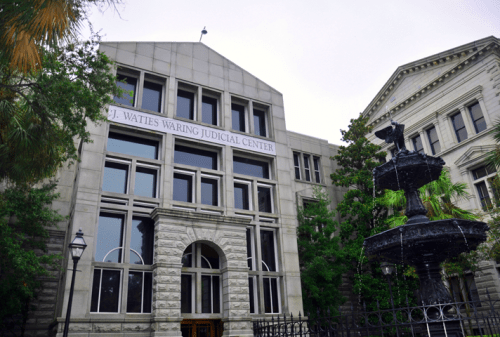
The J. Waites Waring Judicial Center in Charleston, SC

Longtime magistrate judge Jacquelyn Austin has been nominated to replace Judge J. Michelle Childs on the U.S. District Court for the District of South Carolina.

Background

Born in 1966, Austin received a B.S. from the University of South Carolina School of Engineering in 1989 and her J.D. from the University of South Carolina School of Law in 1996. Austin then clerked for Judge Matthew Perry on the U.S. District Court for the District of South Carolina and then joined Womble Carlyle Sandridge & Rice, P.C. as an Associate. In 2006, Austin became a partner at the firm.

In 2011, Austin was appointed to be a U.S. Magistrate Judge for the District of South Carolina, where she currently serves.

History of the Seat

The seat Austin has been nominated for opened on August 2, 2022, with Judge J. Michelle Child’s elevation to the U.S. Court of Appeals for the D.C. Circuit. Austin was one of two candidates under consideration for the seat along with former federal prosecutor Beth Drake. See John Monk, Names of SC Judge, Lawyer Floated to Succeed Michelle Childs on Federal Bench, The State, Dec. 26, 2022, https://www.thestate.com/news/politics-government/article270051712.html.

Legal Experience

Between her clerkship and her appointment to the bench, Austin worked at the firm of Womble Carlyle Sandridge & Rice, P.C. A notable case that Austin worked on was a suit brought by several Greenville state court judges against the County, arguing that the County had illegally recorded telephone calls between their offices and the Detention Center. See Abraham v. City of Greenville, SC, 237 F.3d 386 (4th Cir. 2001). Austin was a part of the legal team for the County of Greenville, who argued that the recordings were permissible as they were conducted as part of ordinary law enforcement proceedings. See id. at 389-90. After a district court trial ended in a jury verdict for the plaintiffs, the Fourth Circuit affirmed. See id. at 388. Austin was also part of the legal team for pharmaceutical giant AstraZeneca, facing a breach of contract claim against Albemarle Corp. See Albemarle Corp. v. AstraZeneca UK Ltd., 628 F.3d 643 (4th Cir. 2010).

Jurisprudence

Since 2011, Austin has served as a U.S. Magistrate Judge in South Carolina, in which capacity, Austin presides over pretrial release and discovery disputes, as well as over cases in which parties consent to her jurisdiction. As part of her pretrial release duties, Austin set a $30,000 secured bond for arms dealer Dustan Lawson, who was accused of providing guns to serial killer Todd Kohlhepp. See Elizabeth LaFleur and Nikie Mayo, Bond Conditions Set for Upstate Man Accused of Supplying Todd Kohlhepp With Guns, Greenville News, Oct. 23, 2017, https://www.greenvilleonline.com/story/news/2017/10/23/dustan-lawson-todd-kohlhepp-guns/789799001/. In doing so, Austin declined Lawson’s motion to reduce the bond to $17000. See id. Lawson ended up posting the bond, see Daniel J. Gross, Lawson Released on Bond in Kohlhepp Federal Firearm Case, GoUpstate, Oct. 23, 2017, https://www.goupstate.com/story/news/2017/10/23/lawson-released-on-bond-in-kohlhepp-federal-firearm-case/18118862007/, and eventually pleading guilty. See Jeffrey Collins, Man Who Bought 12 Guns for Serial Killer Pleads Guilty, Associated Press, May 24, 2018, https://apnews.com/article/2fece690bd3e43cca55c7b475b2934ad.

Notably, Austin presided over a civil rights suit brought by Stephon Hopkins, a Greenville man claiming that a police officer intentionally slammed his head in a car door during an arrest. See Hopkins v. Walters et al., 6:2021-cv-00553. Austin allowed the case to move forward to a jury, and after a week-long trial, the jury returned with a verdict for the defendant. See Dustin George, Verdict Reached in Lawsuit Over 2019 Arrest in Greenville County, WSPA.com, Apr. 21, 2023, https://www.wspa.com/news/local-news/verdict-reached-in-lawsuit-over-2019-arrest-in-greenville-county/.

Overall Assessment

Austin’s nomination is a culmination of a search process that has lasted well over a year, and likely reflects the support of her home-state senators. Given this, Austin is expected to have a relatively comfortable confirmation.

Seth Aframe – Nominee to the U.S. Court of Appeals for the First Circuit

After the withdrawal of their first nominee to fill the final vacancy on the First Circuit, former New Hampshire Attorney General Michael Delaney, the Biden Administration is trying again with federal prosecutor Seth Aframe.

Background

Born in Boston, Massachusetts in 1974, Seth Robert Aframe received a bachelor’s degree summa cum laude from Tufts University in 1996 and then received a J.D. from Georgetown University in 1999. Aframe then clerked for Justice Judith Cowin on the Massachusetts Supreme Judicial Court before joining Choate Hall & Stewart in Boston as an Associate.

In 2003, Aframe moved to New Hampshire to clerk for Judge Jeffrey Howard on the U.S. Court of Appeals for the First Circuit. In 2007, he became a federal prosecutor with the U.S. Attorney’s Office for the District of New Hampshire where he currently serves as Appellate chief and Chief of the Criminal Division.

History of the Seat

Upon the recommendation of New Hampshire Senators Jeanne Shaheen and Maggie Hassan, Aframe has been nominated for a vacancy on the U.S. Court of Appeals for the First Circuit. This seat opened when Judge Jeffrey Howard took senior status on March 31, 2022. On January 18, 2023, former New Hampshire Attorney General Michael Delaney was nominated to fill this seat. However, Delaney faced bipartisan opposition based on his role in defending St. Paul’s School against a lawsuit brought by a plaintiff alleging sexual assault at the school and withdrew on May 18, 2023. Approximately a week after the withdrawal, Aframe reached out to Shaheen expressing his interest in the position. After interviewing with the senators and then with the White House in July 2023, Aframe was nominated on October 4, 2023.

Legal Experience

After a clerkship, Aframe started his career at Choate Hall & Stewart in Boston, where he worked in commercial litigation. For example, Aframe represented Lucent Technologies in defending against a disability discrimination claim brought by a former employee who was dismissed for allegedly falsifying company records. See Desando v. Lucent Technologies, 193 F. Supp. 2d 358 (D. Mass. 2002).

After an extensive stint as a law clerk at the First Circuit, Aframe joined the U.S. Attorney’s Office for the District of New Hampshire, where he has served for the last sixteen years. He started in the Civil Division of the office. Since 2010, Aframe has served as the Appellate Chief of the U.S. Attorney’s Criminal Division, in which capacity he has argued approximately 100 cases before the First Circuit, in addition to trying several cases in the District of New Hampshire. Among his trials, Aframe was lead counsel in a ten day money laundering and conspiracy trial involving a fraudulent scheme to convert fraudulent proceeds into bitcoin. See United States v. Freeman, 21-cr-41-JL (D.N.H.)

Among Aframe’s notable appeals, he successfully defended a trial verdict of guilt wherein the defendant was a physician who had received kickbacks to prescribing a fentanyl spray to his pain patients. See United States v. Clough, 978 F.3d 810 (1st Cir. 2020). The First Circuit, in affirming the verdict, found that the government need not prove an explicit connection between the fees received by the physician and the prescriptions in order to prove a conspiracy. See id. In another notable case, Aframe successfully defended a conviction under the federal cyberstalking statute against a First Amendment challenge. See United States v. Ackell, 907 F.3d 67 (1st Cir. 2018).

Outside the criminal context, Aframe successfully persuaded the First Circuit that the Department of Health and Human Services had appropriately withheld internal emails and redacted portions of manuals produced in a Freedom of Information Act request relating to the provision of a grant to Planned Parenthood. See New Hampshire Right to Life v. United States Department of Health and Human Services, 778 F.3d 43 (1st Cir. 2015).

Political Activity

Aframe has two donations to his name, one to Democratic gubernatorial candidate Colin Van Ostern, and one to Sen. Jeanne Shaheen.

Overall Assessment

If there is one lesson that the Biden Administration can take away from the loss of the Delaney nomination, it is that unexpected issues can sometimes tank otherwise qualified nominees. Aframe, like Delaney, has extensive legal experience in the New Hampshire community and is generally well-respected. However, unlike Delaney, Aframe’s confirmation hearing focused largely on issues of sentencing that are unlikely to draw Democratic opposition. As such, while Aframe, at least barring the unexpected, looks favored to join the federal bench in due course.

John Russell – Nominee to the U.S. District Court for the Northern District of Oklahoma

As part of a deal to fill two vacancies on the severely overburdened Northern District of Oklahoma, the White House has agreed to nominate Tulsa litigator John Russell.

Background

A native Oklahoman, John David Russell was born in 1963 in Enid. Russell received a B.S. with honors from Oklahoma State University in 1985 and a J.D. with distinction from the University of Oklahoma College of Law in 1988. Russell then started at Bracewell & Patterson in Washington D.C. and three years later joined the U.S. Department of Justice Tax Division. In 1993, Russell returned to Oklahoma to Sneed Lang Adams & Barnett and two years later became a federal prosecutor with the U.S. Attorney’s Office for the Northern District of Oklahoma.

In 2002, he returned to private practice, first briefly at the firm of Gardere Wynne Sewell and then at Fellers Snider Blankesnhip Bailey & Tippens. In 2015, Russell joined the Tulsa office of GableGotwals as a Shareholder. It is a position he currently holds.

History of the Seat

Russell has been nominated to replace Judge John Dowdell on the U.S. District Court for the Northern District of Oklahoma. Dowdell took senior status on June 21, 2021.

Political Activity

Russell has a limited political history, with his sole political donation being one to Oklahoma Insurance Commissioner Glen Mulready in 2018.

Legal Experience

Russell has worked as an attorney for around thirty-five years, working both in private practice and with the federal government. He started his career in private practice in Washington D.C. working on regulatory and antitrust matters before he moved to the Department of Justice Tax Division.

From 1995 to 2002, Russell worked as a federal prosecutor in Tulsa, primarily prosecuting white collar cases. Of the cases he handled during this time, Russell headed a four-week jury trial for conspiracy, money laundering, and wire fraud. See United States v. Lorson and Evans, Case No. 97-CR-135-TCK (N.D. Okla. 1998).

Since 2002, Russell has been in private practice in Tulsa, working on both civil litigation and white collar criminal defense. Notably, as a criminal defense attorney, Russell challenged the constitutionality of the federal bar on felons possessing firearms, arguing that the ban violates the Second Amendment under the Supreme Court’s ruling in New York State Rifle & Pistol Association v. Bruen. See United States v. Coombes, 629 F. Supp. 3d 1149 (N.D. Okla. 2022). Judge Gregory Frizzell rejected the challenge as applied to the indictment of Russell’s client. See id. at 1152. On the civil side, Russell notably defended United American Insurance Company in a nationwide class action lawsuit alleging fraud in the health insurance policies being offered. See Smith et al. v. Collingsworth et al., Case No. CV-2004-742-2 (Ark. Cir. Ct. Saline Cnty.).

Writings and Statements

Throughout his legal career, Russell has occasionally written on the law. For example, Russell coauthored an article on strategies for fighting criminal tax penalties. See John D. Russell and Andrew J. Hofland, Managing Expectations in Criminal Tax Defense – Yours and Your Client’s, 90 Okla. B.J. 18 (2019) (available at https://www.okbar.org/a2j/wp-content/uploads/2019/03/OBJ2019March.pdf#page=20). In another article, Russell discusses the impact of the Supreme Court decision in New York State Rifle & Pistol Association v. Bruen on criminal prosecutions, suggesting that criminal defense attorneys use the decision to push back against enhancements or bond conditions involving firearms. See John D. Russell, Andrew J. Hofland, & Justian A. Lollman, The New Second Amendment Frontier: Litigating the Constitutionality of Firearm Offenses Under Bruen’s Text-and-History Standard, 94 Okla. B.J. 7 (Mar. 2023) (available at https://www.okbar.org/barjournal/march-2023/the-new-second-amendment-frontier/).

Overall Assessment

With the strong support of his home state senators, Russell should have a relatively comfortable confirmation process, and will likely join the bench by early next year.

Sara Hill – Nominee to the U.S. District Court for the Northern District of Oklahoma

An accomplished litigator who has served the Cherokee Nation in multiple capacities, Sara Hill has been tapped for a seat on the U.S. District Court for the Northern District of Oklahoma.

Background

Sara E. Hill received a Bachelor of Arts cum laude from Northeastern State University in 2000 and a Juris Doctor from the University of Tulsa College of Law in 2003. She then joined the Cherokee Nation as a deputy attorney general. In 2015, Hill was appointed to be the Secretary of Natural Resources for the Cherokee Nation, and in 2019, she was appointed to be Attorney General for the Cherokee Nation. She held that position until returning to private practice a couple of months ago.

History of the Seat

Hill has been nominated to a seat on the U.S. District Court for the Northern District of Oklahoma vacated by Judge Claire Eagan, who took senior status on October 1, 2022.

Political Activity

Hill has made a handful of political donations throughout her career, all to Democrats, including to presidential candidate Hillary Clinton in 2016.

Legal Experience

Hill started her legal career as a Deputy Attorney General with the Cherokee Nation Attorney General’s Office (the Cherokee Nation being one of the largest federally recognized Native American tribe in Oklahoma). In one of the most notable cases she handled during her time in this role, Hill represented the Nation in seeking to intervene in a lawsuit brought by the state of Oklahoma against Tyson Foods, alleging improper pollution in the Illinois River Watershed. See Oklahoma ex rel. Edmondson v. Tyson Foods, Inc., 619 F.3d 1223 (10th Cir. 2010). However, the district judge denied the Nation’s motion to intervene in the lawsuit finding it untimely, and the Tenth Circuit affirmed. See id.

Between 2015 and 2019, Hill served as the Secretary of Natural Resources for the Cherokee Nation and in 2019, became the Nation’s Attorney General. Hill’s tenure coincided with a number of notable Supreme Court decisions on Indian law, including its famous ruling in McGirt v. Oklahoma that dramatically expanded the jurisdiction of tribal courts. See 140 S. Ct. 2452 (2020). McGirt upended many convictions in Oklahoma, which were retroactively challenged for lack of jurisdiction. See, e.g., Spears v. State, 485 P.3d 873 (Okla. Ct. Crim. App. 2021) (finding that Oklahoma lacked jurisdiction to prosecute Defendant convicted of First Degree Murder). The Oklahoma Court of Criminal Appeals eventually found that McGirt did not require wholesale retroactive application. See State ex rel. Matloff v. Wallace, 497 P.3d 686 (Okla. Ct. Crim. App. 2021).

In other matters, Hill represented the Nation in a successful suit against the State of Oklahoma in finding that the legislature renewed the Nation’s compact to handle gaming activities for fifteen years. See Cherokee Nation v. Stitt, 475 F. Supp. 3d 1277 (W.D. Okla. 2020). Hill also represented the Nation in a suit against Lexington Insurance seeking recovery for economic losses suffered as the result of the Covid-19 pandemic. See Cherokee Nation v. Lexington Insurance Co., 521 P.3d 1261 (Okla. 2022).

Writings and Statements

In her time as Attorney General for the Cherokee Nation, Hill has occasionally commented on developments in the law, particularly as it relates to Indian tribes. For example, Hill was sharply critical of the Supreme Court’s decision in Oklahoma v. Castro-Huerta holding that Oklahoma had concurrent authority to prosecute crimes in Indian country. See Chad Hunter, SCOTUS Hands Down ‘Terrible’ Jurisdiction Decision, AG Says, Cherokee Phoenix, Jul. 13, 2022, https://www.cherokeephoenix.org/news/scotus-hands-down-terrible-jurisdiction-decision-ag-says/article_58095620-02af-11ed-884d-7ff719d7680f.html. While Hill called the decision “heartbreaking”, she added “We get good decisions. We get bad decisions. But our obligations to our citizens don’t change.” See id. (quoting Sara Hill).

Overall Assessment

Despite her youth, Sara Hill brings to the federal bench both extensive legal experience and deep Oklahoma ties. Notably, in a state defined by its strong Native American heritage, Oklahoma has not seen the appointment of a federal judge with Native American heritage since Judge Michael Burrage in 1994. Despite some criticism that Hill has gotten from Gov. Kevin Stitt (whom she nominally (and successfully) sued in Cherokee Nation v. Stitt), Hill has received the support of her home state senators. As long as she maintains that support, she should be confirmed comfortably.

Sarah Russell – Nominee to the U.S. District Court for the District of Connecticut

Quinnipiac University law professor Sarah Russell has devoted her career to advocating for the rights of the indigent. She has now been nominated to a seat on the federal bench in Connecticut.

Background

Born in Boston in 1976, Sarah French Russell received a Bachelor of Arts degree magna cum laude from Yale College in 1998 and her Juris Doctor from Yale Law School in 2002. After graduating law school, she clerked for Judge Michael Mukasey on the U.S. District Court for the Southern District of New York and then for U.S. Court of Appeals Judge Chester Straub on the Second Circuit, before joining the Office of the Federal Public Defender in New Haven, Connecticut. In 2007, Russell moved to academia as a Scholar in Law at Yale Law School. Since 2011, Russell has been a Professor at Quinnipiac University School of Law.

History of the Seat

Russell has been nominated to a vacancy on the U.S. District Court for the District of Connecticut opened by Judge Sarah Merriam’s elevation to the U.S. Court of Appeals for the Second Circuit on September 28, 2022.

Legal Career

Russell started her legal career as a federal public defender in Connecticut representing indigent defendants. While in this role, Russell notably argued against now Second Circuit Judge William Nardini that her client’s prior Connecticut conviction for distribution of a controlled substance counted as a “controlled substance offense” for federal sentencing purposes. See United States v. Savage, 542 F.3d 959 (2d Cir. 2008). The Second Circuit agreed with Russell that the record for the prior plea was insufficient to establish that he had plead guilty to a controlled substance offense. See id. at 967.

In 2007, Russell shifted to academia. First at Yale University and then at Quinnipiac University, Russell supervised clinical work relating to civil cases that run collateral to criminal ones, including prison conditions and reentry. Notably, Russell argued the first case in the nation to strike down the Bureau of Prisons process for imposing reimprisonment on those on home confinement, finding that the procedure violated Due Process rights. See Tompkins v. Pullen, No. 3:22-CV-00339, 2022 WL 3212368 (D. Conn. Aug. 9, 2022). In another notable case, Russell secured a ruling that requiring a Muslim inmate to be subjected to non-emergency pat searches from male employees. See Forde v. Baird, 720 F. Supp.2d. 170 (D. Conn. 2010).

Political Activity

Russell has been a frequent donor to Democratic candidates, including Gov. Ned Lamont and DNC Chair Jaime Harrison.

Writings

As an academic, Russell has particularly focused on issues of criminal sentencing, on which she has written extensively. See, e.g., Sarah F. Russell, Second Looks at Sentences Under the First Step Act, 32 Fed. Sent. R. 76 (2019). Notably, Russell has criticized the use of “recividist enhancements” or mechanisms in sentencing guidelines that enhance a sentence based on prior criminal history. See Sarah French Russell, Rethinking Recidivist Enhancements: The Role of Prior Drug Convictions in Federal Sentencing, 43 UC Davis L. Rev. 1135 (2010) (available at https://lawreview.law.ucdavis.edu/issues/43/4/articles/43-4_russell.pdf). In the article, Russell suggests that the enhancements are not justified by traditional sentencing criteria, and can lead to significant sentencing disparities. See id. at 1142.

Overall Assessment

Given her extensive experience as an advocate and an academic, there is plenty in Russell’s background to draw opposition during the confirmation process. However, while Russell’s nomination is likely to be contentious, she is nonetheless favored to join the bench, and will likely be a liberal presence on the court.