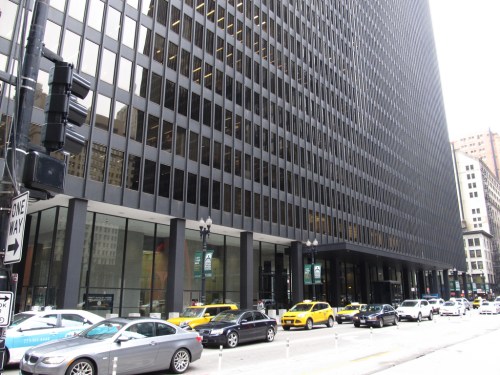
The Dirksen Courthouse - where the Northern District of Illinois sits.
U.S. Magistrate Judge Sunil Harjani has two decades of experience litigating before the Northern District of Illinois and the Seventh Circuit that he can bring to the bench.
Background
Harjani received a Bachelor of Arts from Northwestern University in 1997 and a J.D. cum laude from Northwestern Pritzker School of Law in 2000. Harjani then clerked for Judge Suzanne Conlon on the U.S. District Court for the Northern District of Illinois and joined the Chicago office of Jenner & Block LLP.
In 2004, Harjani became senior counsel with the U.S. Securities and Exchange Commission and shifted to the U.S. Attorney’s Office for the Northern District of Illinois in 2008. Since 2019, Harjani has served as a U.S. Magistrate Judge on the U.S. District Court for the Northern District of Illinois.
History of the Seat
Harjani has been nominated for a seat on the U.S. District Court for the Northern District of Illinois. He is expected to be submitted for the seat that opened on December 26, 2023, when Judge Thomas Durkin moved to senior status.
Legal Career
Harjani started his legal career at the Chicago office of Jenner & Block, where he argued before the Seventh Circuit that a prisoner’s claim based on a beating at the jail is not required to be exhausted under the Prisoner Litigation Reform Act before a suit is filed. See Smith v. Zachary, 255 F.3d 446 (7th Cir. 2001). The Seventh Circuit disagreed in a 2-1 decision, finding that the PLRA applied to the prisoner’s claim. See id. While at Jenner, Harjani also served as a legal adviser working with the North-Western University Legal Clinic. See, e.g., Johnson v. Bett, 349 F.3d 1030 (7th Cir. 2003).
In 2004, Harjani shifted to the Securities and Exchange Commission, where he worked on enforcement actions for insider trading against Roger Blackwell. See U.S. Sec. & Exchange Comm’n, 477 F. Supp. 2d 891 (S.D. Ohio 2007). Subsequently, Harjani became a prosecutor with the U.S. Attorney’s Office for the Northern District of Illinois. While with the office, Harjani argued a number of appeals before the Seventh Circuit. See, e.g., United States v. Turner, 569 F.3d 637 (7th Cir. 2009); United States v. Bright, 578 F.3d 547 (7th Cir. 2009); United States v. Pilon, 734 F.3d 649 (7th Cir. 2013).
Jurisprudence
Harjani has served as a U.S. Magistrate Judge since his appointment in 2019. In this role, he presides over arraignments, bail hearings, and non-dispositive motions. He also handles civil cases by consent of the parties.
Among his notable opinions as U.S. Magistrate Judge are two relating to government applications for warrants. In one case, Harjani approved a geofence warrant in relation to an arson investigation. See In the Matter of the Search Warrant Application for Geofence Location Data Stored at Google Concerning an Arson Investigation, 497 F. Supp. 3d 345 (N.D. Ill. 2020). In his opinion, Harjani noted that geofence warrants, which allow the government to note the presence of various cellular and mobile devices within certain coordinates, can be unconstitutional if laid out too broadly, but that, in this case, the specific areas sought were covered by probable cause. See id. at 353.
In comparison, Harjani approved government use of a cell site simulator to identify the cell phone number of a suspected narcotics trafficker. See In the Matter of the Use of a Cell-Site Simulator to Identify a Cellular Device in a Narcotics Trafficking Case, 623 F. Supp. 3d 888 (N.D. Ill. 2022). Harjani specifically identified geographic limitations on the warrant that he noted would render it permissible under the Fourth Amendment. See id. at 894-95.
Writings
Harjani has frequently written on the law, going back to his time as a law student. See Sunil R. Harjani, The Convention on Contracts for the International Sale of Goods in United States Courts, 23 Hous. J. Int’l 49 (2000-2001). See also Sunil R. Harjani, Litigating Claims Over Foreign Government-Owned Corporations Under the Commercial Activities Exception to the Foreign Sovereign Immunities Act, 20 Nw. J. Int’l L. & Bus. 181 (1999-2000). Later, as a federal prosecutor, Harjani authored a discussion of the intersection of the work-product privilege and attorney notes taken during cross-border investigation interviews. See Sunil R. Harjani, Privilege and Interview Notes in Cross-Border Investigations, 45 Litigation 13 (2018-2019).
As a magistrate judge, Harjani was equally prolific. See, e.g., Sunil R. Harjani, Top Ten Mistakes in Internal Investigations Reports, 36 GPSolo 70 (2019). In one article, Harjani outlined different strategies that attorneys should embrace when approaching settlement conferences, based on where in the life of the case they land. See Hon. Sunil R. Harjani, Timing is Everything: When to Ask for a Settlement Conference, 49 Litigation 51 (2022-2023), https://www.ilnd.uscourts.gov/_assets/_documents/_forms/_judges/Harjani/Timing%20is%20Everything.pdf.
Overall Assessment
As a sitting magistrate judge with a long history of litigation, Harjani should be a safe choice for the Northern District of Illinois. Barring anything unusual, he should be confirmed in the next 3-4 months.




 The Vetting Room